What I Learned From Standing in a Local Election

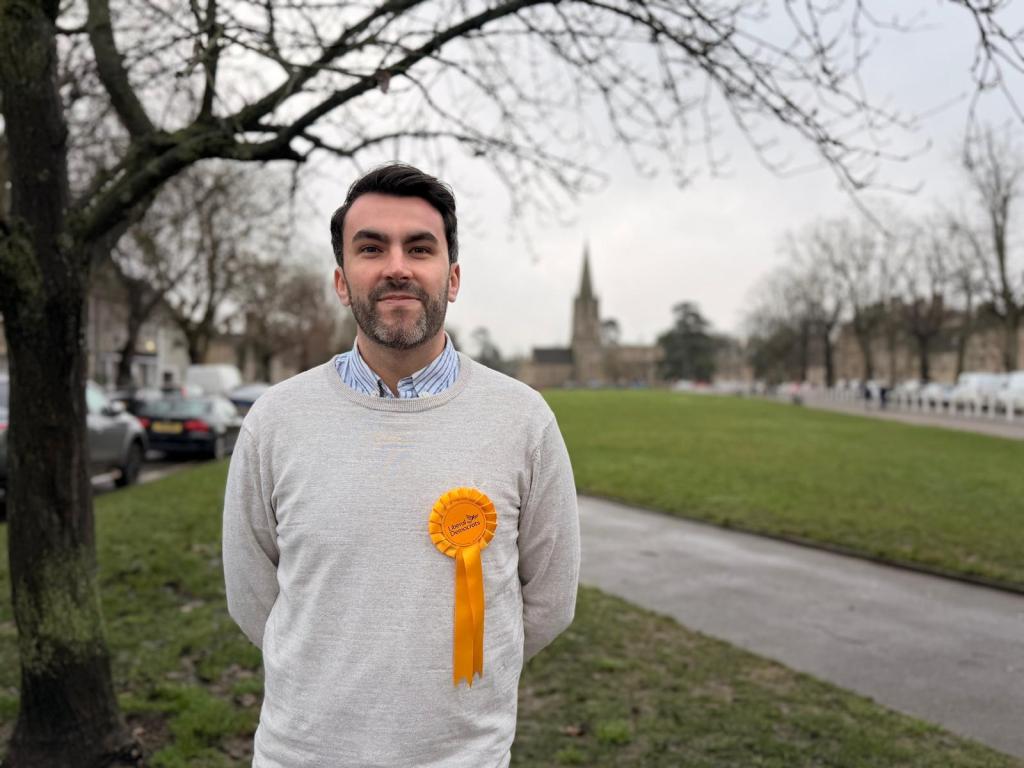
On Friday the 8th May this year, I found myself in a new and unfamiliar position: standing in the sports hall of my local leisure centre, the distant sounds of a spin class echoing in the background, as I watched the count of the West Oxfordshire District Council (yes, the one that Jeremy Clarkson hates) local election unfold. What made the whole thing even stranger is that I was specifically watching a pile of ballots that had my name on.

How did I get there? That’s a good question, and if you are surprised to read about this, I can assure you it was just as much of a surprise to me when the opportunity first came about. To cut a rather long and convoluted story short, the simple answer is that it all started when I met my local MP, Charlie Maynard, at a work event at the House of Commons towards the end of last year. Charlie is a shining example that there are still plenty of good politicians out there. He’s enthusiastic, personable and most importantly, genuinely cares about his constituency and its residents.

I told Charlie that I was interested in politics and would like to find out how I could get more involved and then a couple of months later, I was asked to stand as the Liberal Democrat candidate for the local council elections in my home ward of Witney East. To say this came out of nowhere was an understatement; I’m not actually 100% sure I had even ever voted in a local election before, and here I was being asked to stand in one. But, as the saying goes, in for a penny, in for a pound. So I accepted, and my campaign began.

In Christopher Nolan-style, let’s jump back to the future, and return to the count that happened on the 8th May. The results of my ward were confirmed, and I finished second on 633 votes, trailing the winning Conservative candidate by a few hundred. All of this is public record and you can see the results in full here if you’re interested. Given the unexpected nature of my decision to stand, I was pretty chuffed with this outcome. I knew it was the mother of all longshots to actually win given where I had started from, so second place and knocking Labour into third was about as good as I could have hoped for (although as you’ll have seen from the rest of the country’s results, I may have had a helping hand from a certain Mr Starmer in that, so cheers Keir!)

Now, this blog is certainly not meant to be a bitter attempt at disputing the results or at  besmirching my fellow candidates, but rather a summary of my experience of standing and campaigning and the things that it has taught me about the British public and the state of our current political climate. I hope you find the below interesting and insightful, and if it encourages a few more younger people to get involved in local politics, then that would be lovely too.

A Lack of Perspective

The central part of any election campaign is canvassing. And if you didn’t know, that’s essentially the process of knocking on people’s doors and trying to convince them to vote for you. On the whole, I found this to be a genuinely brilliant experience. Social media may lead you to believe that we all live in a terminally divided society where people are just waiting for a chance to attack anyone who doesn’t share their own beliefs, but the reality is that we British are actually all rather incurably polite at heart.

We’re also more similar than you would think, especially when it comes to local issues, and whilst obviously there were specific things that would only be relevant to Witney, I’m sure this would be fairly universal across the country. People basically just want well-maintained roads, minimal disruption to their commutes, safe neighbourhoods and good services for their children. And this was true whether they were a Lib Dem Voter or not.

However, there was one theme that did start to irritate me the more I canvassed, and it wasn’t anything specific anyone said, but rather a frequent malady that many people seemed to suffer from, and that’s a lack of perspective. The amount of times I stood in the doorway (or sometimes even porch…) of an amazingly beautiful house on one of Witney’s many lovely secluded little cul-de-sacs, and listened to the home-owner tell me about how the town wasn’t what it used to be, and how everything had basically gone to ruin.

Now, please don’t misunderstand me. I wouldn’t have been running if I didn’t recognise that Witney does have some things that need fixing, but then so does literally every other town in the UK. And some of the issues that were regularly mentioned- decline of the high street, unsustainable growth in housing, busier roads- are literally just symptoms of the last 40 years of socio-economic development.

The problem is not that these people are wrong, they aren’t, but its that they seemingly have nothing to compare it to, and therefore are of the opinion that their particular situation is as bad as anyone else is facing. Without naming and shaming anywhere specifically, you wouldn’t have to venture far outside of West Oxfordshire before you quickly realised that actually maybe things really aren’t that bad at home after all. And this would be a useful exercise for everyone to partake in. The grass isn’t always greener on the other side, and it might just make you appreciate how good your own lawn is looking in comparison. 

The Impression of Politicians

The other fairly universal theme amongst everyone I canvassed probably wouldn’t surprise you, and that’s the total and complete lack of faith in politicians of any kind. There were a lot of people who were so disenchanted by the whole system that they didn’t feel that they could vote for anyone, and there was also the general sense that it didn’t matter which party got elected, as there wouldn’t actually be any noticeable change. Difficult to argue with that.

The other thing that I found interesting was that people also seem to have a very strong fixed impression in their mind of what a politician looks and acts like. I genuinely lost count of how many times I was told that I seemed either “too young”, “too nice” or most worryingly, “too normal” to be running in an election. The young argument I kind of understand and accept, and the truth is that I probably was in the youngest 5% of people in the sports hall during the count. This is an issue, but one that can be resolved.

The other two were more damning, and speaks to how the public perception of what a politician is has now become so twisted that a lot of ordinary people just don’t think that other ordinary people become politicians anymore. Due to going through this process, I know that this isn’t true, and actually there are plenty of honest, decent people within politics, particularly at a local level. However, perhaps it speaks to the kinds of people who are most visible in the political sphere, and what attributes are most valued within Westminster circles. Fixing that is going to take a lot longer.

The Two-Way Impact of Reform

Phew, getting into slightly more controversial waters here. There’s nothing I can write about the Reform movement that hasn’t already been said- you all know the deal. It’s undeniably effective, and intrinsically divisive, no matter which side of that divide you fall on. You know which party I stood for, so you probably already know my stance, but that’s not what I want to talk about here.

One of the interesting side effects of the rise of Reform is the effect it is having on local elections, most notably in actual turnout, with nearly all wards in West Oxf seeing a huge increase in turnout percentage this year. This is obviously partly due to the rise in people voting for Reform that wouldn’t normally vote at all, but it’s also having a knock-on effect of motivating people to vote for anyone but Reform. I think for a lot of left-leaning voters, it’s one thing the Torys winning again, but its quite another to let Reform in.

One example of this sentiment is a gentleman who greeted me at his door with his fists raised, because he thought I may have been a Reform candidate. Luckily, he lowered them when I told him I wasn’t. Now, the picture will be different in every area of the country, but my experience is that the anti-Reform movement is just as fervent as the Reform one, and the issue is that people aren’t often sure which party actually offers the best chance of keeping them out.

As a final musing on this, I would be genuinely interested in the outcomes of a local or general election where voting was mandatory. Of course, you’d probably find a lot of new Reform voters who’d have otherwise stayed at home, but I guarantee you’d also find a lot of previously passive people now emboldened to find a reason to vote for literally anybody else.

We’re Not as Doomed as You’d Think

The final thing I learned was the most important one, and it is the main thing that I’ve taken from what has been an incredibly rewarding experience. I have been in the camp of the group that I mentioned earlier, feeling so downtrodden about both the political climate and system, that you start to lose faith in the concept as a whole.

I am delighted to report that is not the case any longer. Firstly, I have met so many wonderful volunteers that are the driving force behind any campaign. These people get involved because they care about their communities, often balancing or even sacrificing other commitments, because they’re passionate about the impact that politics can have. I also got to know many of my fellow Lib Dem candidates and I can say without fail they are all hard-working, kind-hearted people who want to make a positive difference, and I’m sure this is replicated across many other parties as well.

Which brings me on to my second point. Politics is inherently competitive, you’re trying to gain (in whatever small way that may be) over your opponents, and inevitably that can easily get nasty if you’re not careful. And yet for me, the heart of our democracy was best demonstrated on the election day, when I stood alongside a volunteer from the Labour and Conservative parties, as we collected the polling numbers of voters as they arrived at the polling station. There was no tension or conflict, we simply had a lovely chat and shared the numbers between us. It was an example of what UK politics still maintains at its core: an unspoken code of decency and respect.

Another example of this was that whilst watching my count, I got chatting to a Conservative candidate in a different ward. We talked openly about the issues we were passionate about, and had a really positive conversation where it became clear that we basically had the exact same values, and if there were areas where we disagreed, these were subtly different interpretations rather than insurmountable moral barriers. The truth is there are no right answers in politics, there are just some that are more wrong than others. And I’m certainly not claiming for a second that I instinctively and infallibly always know which are which.

So, that is my recount of an unexpected, exciting period in my life. Will I run again? I honestly don’t know at this point. Do I feel better about the state of our political institutions and the fundamentals of our democracy after standing?

Without a shadow of a doubt.

Premier League Predictions 2025-26

One week to go until football is back. Which means we’re in prime prediction season. And, whilst I think I say this at the beginning of every season, it really does feel like it could be an exciting and unpredictable one, after last year’s comparatively underwhelming campaign. The Premier League is at its best when it has a genuine season-long title race, when the three promoted sides are able to compete immediately, and when as many teams as possible stay in European contention. We only got one out of three last year. Here’s hoping for a jackpot this time around.

I’d like to throw in the disclaimer that this is being done ahead of the first game, and therefore with three weeks of the transfer window still remaining. As it stands, Alexander Isak is not a Liverpool player, Everton, Newcastle and Chelsea (of course) still seem like they have lots of business left to complete, and Fulham seem to have forgotten there is a transfer window open at all.

So, here we go. Some of these will hopefully be bang on the money, some will at least be along the right lines, and some will look like absolute howlers come May (I did predict Nott’m Forest to finish 20th last year…). It’s all part of the fun!

20th– Burnley

From the glory days of prime Dycheball, Burnley have now seemingly become the new Norwich, doomed to be an eternal yo-yo club. Of the three promoted sides, they’ve had by some distance the worst window. Their promotion was built on a record-breaking defence, but they’ve lost two crucial pillars of that in goalkeeper James Trafford and centre-half CJ Egan-Riley. They also seem to have ticked off all the classic promotion “no-no’s”: Signing over-the-hill legends (Kyle Walker); Big Club rejects (Broja, Ugochukwu) and loan signings who looked good in the Championship but aren’t Premier League quality (Marcus Edwards, Jaidon Anthony). They have rock-bottom written all over them.

19th– Sunderland

It is a testament to the business Sunderland have done this summer that I haven’t put them last. In fact, when they won that dramatic play-off final, they looked like the biggest threat to Derby’s record low points total of 11. They needed to invest to have any chance whatsoever and the signings of the likes of Xhaka, Adingra and Reinildo look like shrewd business. They still look way short of having enough to actually survive, but at least they look like they’ll put up a decent fight.

18th– Leeds

I hate doing this, but I refused to predict the three promoted sides going straight back down in the last two years and look how that turned out. The gap is just so gigantic these days, that it feels like it would take a complete self-implosion from one of the established seventeen clubs for them to be dragged down into a relegation spot. Leeds look like they have the best chance of breaking the trend, but they may have been better off sacking the man who got them promoted, Daniel Farke, given his abysmal Premier League record. I’d be amazed if he lasted the season, but it’s a question of who replaces him and how much ground they will have to make up, which will dictate whether Leeds will survive.

17th– Brentford

It’s not quite a self-implosion, but Brentford are seemingly trying their hardest to give the promoted teams a fighting chance this year. Their charismatic manager, Thomas Frank, has left for Spurs and they’ve sold their captain, Norgaard, their best player, Mbeumo, and seemingly are resigned to losing another 15-goal striker in Wissa. I really don’t understand the appointment of Keith Andrews as their new manager; the standard of managers in the Premier League is now so high that I don’t think you can take a chance on a complete novice anymore. Again, I’d be amazed if he was still there in May.

16th– West Ham

The importance of timing in football has never been so clear as in the case of West Ham. This time last year they had the chance to rebuild an ageing squad and implement a shift in style after the departure of David Moyes. They handed a significant transfer war chest to new manager Julen Lopetegui and sporting director Tim Steidten. Neither made it to the end of the season. Twelve months on, West Ham are now short of cash, and the manager they probably should have appointed in the first place, Graham Potter, is stuck with a squad woefully ill-equipped for his style of football. Honestly, if they didn’t have their talisman, Jarrod Bowen, I could see the Hammers going down.

15th– Wolves

As they seem to do most years, Wolves have had a low-key summer. They lost their best player in Matheus Cunha, but that was at least gotten out of the way very early, so there’s been plenty of time to reinvest. His likely replacement is Jhon Arias, who needs to hit the ground running. The reason I’ve ranked Wolves above the previous two is simply the stronger relationship between manager and fan base. Whereas Andrews and Potter look like early sacking contenders, Vitor Pereira still has momentum on his side following his brilliant end to last season. That could be enough to keep their heads above water once again.

14th– Nott’m Forest

Okay, time for the first rogue shout. Forest were undoubtedly the story of last season, going from relegation candidates to competing for Champions League football in a genuinely sensational turnaround. However, there were signs that teams were working out their direct, counter-attacking style towards the end of the last campaign and this year they will have Thursday-Sunday football to contend with, which has so often been the kiss of death for over-achieving sides. At some point in the latter stages of the season, they’ll have to sacrifice the weekend games to focus on big European ties, and I think that’ll cause them to drop into mid-table mediocrity.

13th– Fulham

Yearly readers of these predictions will know I have a habit of underestimating Fulham. It is a testament to Marco Silva that he has now established the Cottagers as a steady, mid-table Premier League team, given the fact they don’t have any stand-out, superstar players. However, the lack of activity this summer has been stark and the cliché is that the second you start standing still in the Premier League, you start falling fast. They’ll be fine, but any lofty ambitions of Europe look a million miles away right now.

12th– Bournemouth

Bournemouth have become the latest club to learn the harsh consequences of over-achieving in modern football. Their best players have been snapped up by Europe’s big boys, and they now look weaker, right at the moment they arguably needed to strengthen, in order to close the gap to the top four/five. Their high-intensity playing style under Iraola will ensure they will remain one of the league’s trickiest away trips, but it also seems to fall away as the season goes on. You fear 9th last year may have been their ceiling.

11th– Crystal Palace

The easiest prediction year in, year out. Palace will have something different to contend with this year at least, with their first European campaign ever after their momentous FA Cup win, even if it’s not in the competition they wanted (or earned) after the controversial UEFA punishment for breaching multi-club ownership rules. If they do end up in the Conference League, then they should go all out to win it. Glasner is a cup specialist and English teams have such an advantage over the rest of the field in UEFA’s third-tier tournament. As for the league, well, somewhere between 12th and 10th, because that’s what happens EVERY. SINGLE. TIME.

10th– Everton

After what has been a truly miserable five years, Everton finally have renewed hope. They have a shiny, new stadium (with a truly horrific name), a returning legend as manager in David Moyes, and some money to spend at last after the Friedkin Group takeover. Progress has been slow on the transfer front, and Moyes has publicly voiced his concerns, but the signings they have made look promising and if they can land a true statement signing like Jack Grealish, then they should be aiming for a first top-ten finish since Carlo Ancelotti was in charge (still can’t believe that actually happened!)

9th– Manchester United

For Manchester United, surely, surely this season cannot be any worse than the last. From the wreckage of a truly dismal 15th place finish, they have recruited a couple of proven Premier League attackers in Bryan Mbeumo and Matheus Cunha, and could be adding a new striker in Benjamin Sesko on top of that. That should certainly solve their lack of goals problem at least, but with United these days, there are just too many problems to fix in one go. Their midfield and defence are still made up of the same players who have consistently underperformed for years. They will be better for sure, but I still think they’re behind the following eight teams, and I can’t see them closing that gap in one summer.

8th– Brighton

Brighton had such an underrated season last year. In what was meant to be a transitional year, they ended up with only one point less than their record tally, and yet there was a sense of disappointment within their fanbase, with the lows of the 7-0 thrashing at Forest possibly being more memorable than the highs, and therefore skewing perception. However, unlike the other teams around them (Bournemouth, Brentford) Brighton have kept hold of all their key players (It was their decision to sell Joao Pedro) and Fabian Hurzeler will have learnt a lot from his first season in the Premier League. If they can find some consistency and stop dropping points against the relegated sides, they could be the biggest threat to the established order this year.

7th– Aston Villa

Villa had one of the great ‘nearly’ seasons last year. Eliminated by eventual winners PSG in the Champions League Quarter-Final, upset by Palace in the FA Cup semi-final, and denied a Champions League place by a controversial refereeing decision on the final day. Their PSR worries have ensured they’ve had to stop their recent heavy spending, but as it stands, they also seem to have kept hold of everyone as well. Honestly, the reason I don’t have them higher is because I think they should, and will, prioritise the Europa League. Unai Emery is the master of that competition, and it’s actually an easier route into the Champions League these days (just ask Spurs!)

6th– Tottenham Hotspur

Speaking of Spurs, they are officially the hardest team to predict this year. I mean, how the hell do you balance a 17th place disaster with the fact they won a European trophy?!  And on top of that, they’ve replaced Big Ange with Thomas Frank, so it feels like another reset moment for them. I really rate Frank, and he has long deserved a chance at a bigger club, but Spurs have proven an enigma even Europe’s greatest coaches couldn’t solve. He’s got the core of a good squad, with the likes of Kulusevski, Solanke and Van De Ven at his disposal. There are so many potential outcomes here, but the one I think is most likely is that Frank returns Spurs to their traditional role on the fringes, and ultimately just short, of the Champions League places.

5th– Newcastle United

Oh, Newcastle. They are surely having the single worst transfer window of all time. From the highs of their first trophy win in 70 years and a return to the Champions League, as well as finally being free of the PSR constraints that have hampered them over the last year or so. At the exact moment they seemed ready to go up a level, they have ended up losing out on at least five major transfer targets, and their best player, Alexander Isak, has also made it clear he wants to jump ship too. Why have I still put them fifth then? Well, even though there is now a chasm between themselves and the four sides above them, none of their major rivals for fifth place have notably strengthened. When Isak does eventually go, they’ll surely have 100 million to spend on one, or more likely two, replacements, whilst their midfield trio, which is their biggest strength, remains in place. Frankly, at this rate, they’ll just be happy to see the window shut, so Eddie Howe can purely focus on the football again.

4th– Chelsea

Three years into the BlueCo project, things finally seem like they are coming good for Chelsea. I was sceptical about the appointment of Maresca and he had a major wobble in the middle of last season, but fourth place and two trophies at the end of his first year in charge was a great achievement. As ever, there’s been another major squad shake-up this summer, but there is finally a strong spine emerging in the side with the likes of Colwill, Cucurella, Caicedo, Fernandez and of course Cole Palmer starting to peak. The performance against PSG in the Club World Cup final has even given me faint hopes of a genuine title challenge, but I’m going to try and be rational and accept that we’re probably still lagging behind the other ‘Big 3’ sides. Getting closer to them and aiming for an 80+ points tally would represent further progress this time around.

3rd– Manchester City

This feels like the first time in a very long time that we’re going into a season without Manchester City as firm title favourites. Last year was the season that time finally caught up to one of the Premier League’s greatest ever sides, and whilst it wasn’t a complete disaster in the end, the drop-off from their usual standards was enormous. They’re undergoing a much-needed rebuild that started early in January, with new signings Cherki, Reijnders and Ait-Nouri adding to an already stacked squad. The question with City is simply how quickly Pep Guardiola will rediscover his mojo and transform them back into the division’s best. With Rodri back from his ACL injury, it does feel like a case of when and not if, but I’m gambling they’ve got at least one more year of transition before they become winners again.

2nd– Liverpool

This is the prediction I’m least sure of. Everything points to Liverpool winning a second consecutive title, given that they’ve spent big to improve an already formidable squad. And if they can land the world’s most coveted striker in Isak on top of that, they will seem fairly unstoppable and will rightly be most people’s favourites. However, I think there are question marks at the other end of the pitch, with the two fullbacks they’ve brought both being known more for their attacking prowess than their defensive nous. And more than anything, I just fear they are due a dip. It’s difficult enough to summon the motivation for another title challenge, let alone with all the emotional trauma they have been through in the post-season.

1st– Arsenal

Arsenal are officially out of excuses. They simply have to win the title this season. There can’t be any blaming the referees, or the lack of a striker, or the ball… Mikel Arteta has to deliver the title or it will be time for them to look for a new manager. In fairness, they did suffer some bad luck with injuries last season, and logic dictates that won’t happen again. A lot of the burden will fall on new striker Viktor Gyokeres, but what will really make the difference is turning draws into wins in tight games, and the goals will also need to come from elsewhere to achieve that. If they can do that, then their league-leading defence should be enough to see them over the line. It’s now or never for them, and perhaps that 1% extra motivation will finally make the difference.  

Tuchel’s First England Squad: A worrying backwards step

After much speculation and anticipation, Thomas Tuchel announced his first England squad this morning. England squad announcements are often more talked about and newsworthy than the games that follow them, and this was no exception.

Many have been looking forward to this new era under Tuchel, after the weary end to Gareth Southgate’s transformative but ultimately incomplete reign, and I even wrote about why Tuchel was such an inspired choice to follow him. Which is why the announcement this morning was so underwhelming; rather than the giant step forward that Tuchel’s appointment was meant to represent, he appears to have taken a confusing backwards step instead.

You’ll have seen the headline inclusions: 34-year old Jordan Henderson returns from the International wilderness, despite currently playing his club football for Ajax in the Eredivisie. Marcus Rashford is back after an upturn in his form since moving to Aston Villa, whilst there is also a place for 34-year old Kyler Walker and even a first ever call-up for 32-year old Dan Burn. Hardly a squad that suggests “Bold New Direction.” Frankly, “Dad’s Army” would be more fitting.

The most worrying and damning thing about this selection is that, whilst I know this isn’t the case, it indicates that Tuchel hasn’t watched any Premier League football since he last managed in the division, back in September 2022. Back then, Henderson, Rashford and Walker would have been absolute shoo-ins for the squad, but things move quickly in the football world and there is rarely room for sentiment once a player passes their peak.

A word on Henderson first. I believe everything Tuchel said about the former Liverpool captain earlier today: he has proved throughout an outstanding career that he possesses considerable leadership qualities and is an important personality in the England dressing room. Those are valid considerations, but they should not be enough to earn you a place in the squad. For context, ex-England internationals Chris Smalling, Andros Townsend and Jesse Lingard are also in their 30’s and are also playing in second-rate leagues around the world. Were they in contention for the squad as well? I’m joking, but you get my point. If you’re not playing in the Premier League or an equivalent standard, that should instantly rule you out from national selection.

If Tuchel desperately needed Henderson’s character around the group, there are other ways of managing that, such as what Southgate did with Tom Heaton in the Euros last summer, essentially bringing him in as an extra body for training and to support the group from an experience and motivation perspective. Maybe Henderson wouldn’t want to do that at this stage of his career, but that might be a better use of his character and leadership skills, rather than him taking the place of a more deserving potential teammate.

Similar to Henderson but perhaps not as extreme, is the case of Walker. Another storied England stalwart of the last ten years, but one who once again time seems to have caught up to. He was targeted and consistently beaten by practically every left-winger in the Premier League for the first half of the season and his January move to AC Milan seemed to signal that even he knew his time at the very top level was at an end.

Rashford, at only 27, is not in this group and should actually be at the very peak of his career. However, he has spent the best part of two years looking like he’d rather be anywhere else than on a football pitch, and whilst his move to Aston Villa does seem to have given him a much-needed new lease of life, his highlights so far have basically been setting up Marco Asensio for a couple of tap-ins. What kind of precedent does it set to the rest of the contenders for the squad that all Rashford seems to have to do is actually try for a change and he’s catapulted straight back into the squad at pretty much the first opportunity?

The strange choices continue. As a Chelsea fan, I love Reece James and know what a world-class player he can be when playing at his very best, but Reece has been plagued with injuries for nearly three years now and surely can’t be relied on as a long-term option. If he picks up another injury whilst away on International duty, that would only come across as gross negligence on Tuchel and England’s part.

And finally, whilst it is hard not to feel delighted for Dan Burn and revel in what a good story his particular footballing journey has been, at 32, is he really the best option we’ve got at centre-half? Can I honestly see him starting a World Cup final against a Mbappe or Yamal? The answer to both is surely, unfortunately no.

The final point I want to make is not about the choices themselves but rather a comment Tuchel made in his press conference and a wider issue that it raises. He claimed that all of the players selected in this squad would be in contention for the World Cup in 2026. Obviously, for the multitude of reasons outlined above, I don’t think that’s true, but that’s not my biggest problem with it.

England’s two games in this latest, godforsaken international break are against Albania and Latvia. I am all for doing things properly and I get that Tuchel wants to start as he means to go on, regardless of the opposition, but should this not represent a perfect opportunity to inject some new blood into the team and try out some new combinations? What benefit is there to giving Henderson, Walker and even Kane another couple of caps? Surely he would be better served giving minutes to the likes of Gibbs-White, Wharton, Branthwaite and Delap among others.

If, for argument’s sake, England couldn’t pick any player with more than twenty caps, we would still win both games comfortably. Latvia are ranked 140th in the world, so let’s be honest, we could rule out all Premier League players and still pick a squad capable of beating them. Albania, at 69th in the world, probably merit a bit more respect, but the point remains.

Even if you dismiss my view, what is a certainty is that Tuchel, like Southgate before him, will pick another, much more important squad ahead of the World Cup in 2026. And I guarantee that when he does, he’ll rule out certain players based on the fact they “don’t have enough international experience.” It’s a self-inflicted problem and one that can only be addressed by bolder, more courageous selections in the run-up to a major tournament. Tuchel has shown he is not willing to do that, and that’s a crying shame.

In fact, the best way to sum it all up is that rather than selecting a squad that looks ahead to 2026, Tuchel seems to have picked one that belongs firmly in 2022.

The Premier League and it’s increasingly heavy centre

In most natural spherical objects, like planets or stars, the centre is typically the heaviest part because the gravitational pull draws denser materials towards the middle, leaving lighter materials on the outer layers. Go with me here, but it is becoming increasingly obvious that the English Premier League, the best division in world football, is afflicted with the same curious sensation.

On the day that Liverpool have surely all but confirmed a record-equalling 20th league title, by easing to a staggeringly comfortable 2-0 victory away at current champions Manchester City, it would be easy to write this off as a comparatively uninteresting season. Equally, it is looking an inevitability that the three promoted sides will be going straight back down to the Championship for the second successive season. The top and the bottom of the league have rarely both been so drama-free simultaneously, but that is partly due to the chaotic clusterf*** that is going on in-between the traditional title and relegation battles.

As it stands, after most sides have played 26 games, only 11 points separate Manchester City in 4th from Crystal Palace down in 13th. Look away Arsenal fans, but that’s the same gap between the Gunners in 2nd and Liverpool at the top. To further illustrate my point, at the same stage last season, the gap between 4th and 13th was a whopping 28 points. I’m using 4th as my marker here as it has traditionally been the last available spot to qualify for the Champions League, but the grouping probably also goes one place higher to include Nottingham Forest in third as well. That’s 11 teams all in one massive congested lump, or 55% of the division. And even more interestingly, this group doesn’t include either Tottenham or Manchester United, who are having statistically catastrophic seasons for sides of their stature and wealth.

The idea of the ‘Big 6’ has been getting less and less relevant for a while now, but this season is surely where the notion has been killed off for good. Also, a quick aside to say that the initial concept for the Super League and it’s closed, NFL-style system has never seemed so ridiculous, at least from an English point of view. It would be easy to say things have never been more competitive but that would actually be a slight simplification. Things have never been closer between the aforementioned 11-13 teams, but that has had the knock-on effect of widening the gap between those established sides and those who come up from the Championship, so you could argue that the evenness across the entire 20-team division has actually decreased.

There are a number of factors that are contributing to this phenomenon, with some simply being a peculiarity that may only apply to this season, and some that are far more deep-rooted. The first thing to mention is the fall of Manchester City. Pep Guardiola has created the most dominant side we’ve ever seen in the Premier League era, amassing record points and winning four titles in a row, whilst establishing a kind of invincible-like dominance that made the idea of even competing with City, let alone taking points off them, unthinkable for practically three-quarters of the league. But as the saying goes, all empires fall, and City have fallen hard this season. Not only has this obviously meant their own league points tally and position have dropped, it’s also had the effect of adding to everyone else’s, as now most teams fancy their changes of getting something out of their fixtures with City.

That may well change next season. For all the wide-ranging theories for City’s demise, they’re going to be a whole lot better simply for having Rodri back, and it wouldn’t overly surprise me if they won the title back at the first attempt next year. However, there is a more general and long-term pattern emerging in the teams below (or now amongst) the traditional title challengers. Put simply, the ‘rest’ are actually pretty bloody close to the ‘best’ these days. Brentford, Brighton, Bournemouth, Fulham and Nottingham Forest are all having fantastic seasons, and have all beaten the big boys at different moments. Aston Villa and Newcastle have both played Champions League football in the last couple of seasons, and are in the mix once again.

And this isn’t an anomaly, this is the result of them hiring some of the world’s best coaches, and investing heavily, and crucially sensibly, in their playing staff. There is plenty of variety and fluctuation in the approaches of the club, ranging from the steady, data-orientated models of Brentford and Brighton, to the chaotic, seemingly scattergun policy of Nottingham Forest, but they’ve all been proven to work over time. Equally, the playing styles are all different from each-other, with each manager having their own principles, and this clash between methods is what makes the league tick, and continues to absorb viewers.

What is arguably the biggest factor of them all though is the quality of players these clubs now possess. And I’m not talking about this in terms of good recruitment, though of course it is due to that as well, but simply that the pool of players that these clubs can now attract has expanded significantly in the last five years. Look at the evidence: Brighton’s front four is better than Chelsea’s (despite our best efforts to copy them in every conceivable way); Brentford have two 15-20 goal-a-season strikers in Wissa and Mbeumo (having only just sold another in Toney); Bournemouth signed Porto’s best striker in Evanilson and an exciting young centre-back from Juventus in Dean Huijsen in the summer; Fulham and Nottingham Forest have done a masterful job of poaching the talent that the ‘Big 6’ could no longer accommodate (Smith-Rowe, Pereira and Wilson at Fulham, Hudson-Odoi and Elanga at Forest); and finally even a team who are 17th and still technically in a relegation battle in Wolves have someone as good as Matheus Cunha upfront.

There is a bigger reason behind this. There was already a financial gap between the Premier League and the rest of Europe, but it has got even bigger after Covid. This has led to a self-contained player-trading network which is completely reliant on the Premier League clubs, and where the wasteful excesses of those at the top of the food chain (Chelsea and Manchester United are most guilty of this, but also Barcelona in La Liga) has led to a trickle-down of top-level talent to those below them. Added to this is that because of PSR, there is no longer the same culture of ‘big-club-bullying’ that there was once was. If a club has a high-value asset (Caicedo and Rice at Brighton and West Ham are good examples of this) they are entitled to sell only at a price of their choice (if they’re even willing to sell at all) and one that should give them ample opportunity to reinvest effectively.

So, where is this leading? And is it actually a good thing? After all, it would be fair to say that no-one is tuning into the best league in the world to see who finishes seventh or eighth. And I do think it may hurt our chances as a nation of dominating European competition (as we did in 2018-19 when we all had four finalists in the Champions and Europa League finals) because our supposedly strongest sides aren’t going to be able to dominate as they once did.

However, I can see a scenario where we get another ‘miracle’ season, (as in Leicester in 2015-16) in the next five to ten years. All it would take is for one of those sides currently locked in the “heavy centre” to manage to keep a ‘golden generation’ together, and for the traditional challengers to all have an off-season at the same time (Liverpool didn’t get the memo this time unfortunately). Villa and Newcastle would probably be the best bets for this, and I suppose the biggest indication of the changing dynamics in England’s elite division is that if they, or someone else, did truly shatter the glass ceiling and win the biggest prize of all, whilst it would still be richly impressive, it wouldn’t actually feel like the ‘miracle’ that it once appeared to be.  

Why Thomas Tuchel is the perfect manager for England

So, almost three months to the day from when Gareth Southgate stepped down after a storied but agonisingly incomplete eight-year spell, we have a new England manager. And it may prove to be a true watershed moment. A German in charge of the England team; a concept that a small (and small-minded) percentage of the population simply cannot accept. Yet, that is not what makes the appointment so ground-breaking. No, the most fascinating thing about the events of the last 24 hours is that the FA may actually have finally got something right.

Let’s get the elephant in the room out of the way first: The “England should only be managed by an Englishman” conundrum. It’s provoked significant debate, with opinions ranging from the articulate (Rory Smith of the New York Times, Gary Neville as per) to the borderline xenophobic/ridiculous (Dean Ashton, Harry Redknapp and The Daily Mail). I am not dismissing the argument in its entirety, but it is founded on some fairly shaky principles to say the least.

Firstly, the claims that the FA have somehow cheated by appointing a foreign coach, and have done what no other national federation would do, are significantly wide of the mark. Look at the International Football managerial scene right now: Portugal are managed by a Spaniard, Belgium by a German, Colombia (who have recently gone 28 consecutive games unbeaten) by an Argentinian. Even Brazil, arguably the proudest football nation of them all, were ready to move high and hell water to appoint an Italian- Carlo Ancelotti- before he ultimately decided to stay at Real Madrid. The idea of “our best against your best” is romantic but flawed. And that particular train left the station a long time ago.

The countries who have the luxury of only appointing managers of their own nationality are the ones who have the deepest pools of strong candidates to pick from, and the ones who are subsequently supplying managers for everyone else- Germany, Spain and Italy being the three main examples of this. England do not have that luxury, and this is where the argument has some relevance. Whilst appointing Thomas Tuchel was 100% the right decision (as the rest of this article will indicate), it should still sound a deafening alarm as to the state of the development pathway for elite English managers in this country.

The FA need to start putting things in place now, so that the next two to three managers after Tuchel are both English and well-qualified, not one or the other. If they’re looking for a place to start, how about enforcing a rule that all English clubs (crucially including the Premier League clubs) have to employ at least one Englishman on their senior managerial staff (be that assistant manager etc). Germany’s current golden generation of managers has been heavily influenced by how many worked under key figures like Ralf Rangnick in their early days (Tuchel and Nagelsmann are examples of this). Give young, upcoming coaches the chance to learn from the leading foreign managers we now have at most of our biggest clubs, so that they are better placed to take the top jobs later down the line.

When it comes to English candidates who are within their rights to feel hard done by this time around, we are really only talking about two people. Eddie Howe and Graham Potter were the names most touted as potential Southgate successors and both certainly have their merits. However, neither can honestly say they are proven winners at the very highest level. For some context to this, Howe and Potter have managed only 13 Champions League games between them. Tuchel has managed 67, including two finals and of course that remarkable triumph with Chelsea in Porto. He is, quite simply, in a different league to any possible English alternative.

For those still not convinced and who are ready to angrily scream the names Sven and Fabio at me, yes, it is true that England have had well-respected foreign managers before and it has not led to any notable upturn in the national team’s fortunes. My retort to that would be that appointing Tuchel now is not just a case of being wooed by the allure of an exotic foreign figure, but a perfect example of “right man, right time.” Sven and Capello came in when the England team were at a low ebb, needing to undertake significant rebuilds and instil culture changes (tasks that neither were particularly well suited to) whereas Tuchel will inherit a ridiculously talented team who have consistently reached the final stages of the most recent major tournaments.

And this is where choosing Tuchel starts to look like a masterstroke. That’s because, for all his obvious managerial talents, his career to this point has proven that he is at his best when used as a kind of footballing mafia cleaner, a la Winston Wolf from Pulp Fiction. Someone to come in, clean up someone else’s mess, turn the situation around (or win a trophy in the sporting sense), and then leave.

It’s basically what he did at Chelsea, with his Champions League win in 2021 being one of the finest coaching achievements of recent years, in turning an unfancied side into canny knockout specialists. His rigid and dynamic formation and tactics even spooked the mighty Pep Guardiola, beating him twice in the lead-up to the final and then “living in his head rent free” to the extent that Pep completely messed up his team selection and dropped Rodri for no apparent reason. That ability to provide a quick winning formula is what England need. Gareth Southgate has done all the hard yards and the hill climbs, all Tuchel needs to do is nail the sprint finish.

That’s why he has only signed a contract to the World Cup in 2026. Whatever happens in USA, Mexico and Canada- whether that be glory or failure- I don’t expect him to continue after that. This is a quick-fix solution, which perfectly suits both parties. A brief stint in international management has become the elite football manager’s version of a ‘semester abroad’- getting a crack at winning a prestigious trophy and then returning to the top tier of European club football, no matter how badly the excursion went. Look at Hansi Flick and Luis Enrique as recent examples of this. Win us the World Cup, Thomas, and then head on to Madrid or Milan or wherever else you fancy, safe in the knowledge you’ll never have to buy your own pint of John Smith’s or a Greggs’ sausage roll ever again.

So, now we’ve established that the “he has to be English” claim is a fruitless one and we’ve looked at the specifics of what makes Tuchel so suited to this England team, the final reason that his appointment was the right one is the simplest of all. FA CEO Mark Bullingham said during Tuchel’s unveiling today that they “wanted to get the best possible candidate.” And as loathe as I am to praise anything the FA do, I think they have managed to do precisely that.

Excluding those who were never going to take the job (Pep was clearly sounded out but unsurprisingly wasn’t interested) Tuchel is probably the outstanding available manager right now. He’s the last person not named Pep or Carlo to win the Champions League. His track record of getting to the final of every competition he entered with Chelsea proves he has a knack of winning knockout games. He knows a lot of the key players well. And his deft negotiating of the uncomfortable Roman Abramovich situation during his final months at Stamford Bridge showed he’s even adept at crisis management, which is inevitably going to be required at some point during his tenure as England coach.

I’d even go as far as to suggest that Thomas Tuchel is objectively the best manager England have ever appointed- at the time of his appointment. Previous England managers have obviously gone down in history for their subsequent achievements, but few would be able to match Tuchel’s CV at the moment when they started their tenure. And the one that could- Fabio Capello- was about fifteen years past his best by the time he was actually named manager, so that was a case of too little, too late.

So, with all that said, I will end on the most exciting prospect of them all. In appointing Thomas Tuchel, the FA have managed to do the unthinkable: They have ensured that England head into the next World Cup with not just arguably the best squad of all the nations, but with arguably the best manager as well. Anyone know the German for “it’s coming home?..”

Premier League Predictions 2024-25

The Premier League’s return is almost upon us. Doing this ahead of every season is a nice reminder of how quickly things can change in the relentless, dog-eat-dog world of top flight football. And each summer break throws up new and intriguing storylines too, with this year’s main themes including Arsenal’s near-impossible quest to dethrone Guardiola’s virtually unstoppable City juggernaut, the rest of the ‘Big 8’ all being incredibly hard to separate, new managers with big questions to answer at West Ham and Brighton, and whether the likes of Palace and Bournemouth can build on impressive early signs under their respective bosses.

On a slightly sour note, it feels as if the gap between the Premier League and the Championship has never been greater, and thus the whole pyramid system has never seemed so broken. Leicester, Leeds and Southampton all looked far, far too good for the Championship last season and yet two of them now return to the top flight looking short of quality compared to the rest of the division. Worse still, the impending points deduction for Leicester (because of yet more PSR breaches) renders the effort of getting promoted back at the first time of asking almost meaningless.

Anyway, the predictions. I didn’t do badly with my guesses last season, so here’s to hoping the following ends up being an accurate reflection of the season ahead!

20th– Nottingham Forest

Forest are one of those teams where it feels like they’ve avoided relegation almost by accident thus far, and that can never be sustained for long. Really, they should have gone down last season, with a poor tally of 36 points (not counting their -4 deduction for PSR troubles). They were just lucky that the three promoted teams were the worst ever trio in Premier League history, but this year I’d argue Leicester, Ipswich and Southampton all look better than Forest. Nuno is a solid, if unspectacular, manager but you just know he’ll be sacked as soon as they go on a winless run and I don’t see anyone else coming in to save them this time.

19th– Leicester

Leicester might have just had the most deflating title-winning post-season of all time. Firstly, their manager was poached by Chelsea, then their best player went with him. There is also the looming threat of a points deduction, which could prove too big an obstacle to overcome for a team that was always likely to be in the bottom third of the table anyway. Steve Cooper is a criminally underrated manager in my view, but he’s also not the inspiring appointment that their fans were craving. In a division as strong as this, they look set to be left behind.

18th– Southampton

I’m not as sure on this pick as I am the previous two, as Southampton look they like have a decent squad, with a promising young manager. I think their issue might be the same one that cost Burnley last year, and that’s their style of play. Playing a risky possession-based style works in the Championship when you have the better players, but giving the ball away in dangerous areas is footballing suicide in the Premier League. Man City 8-0 Southampton already has an ominous, inevitable ring to it…

17th– Fulham

I say it every year, but I swear I don’t have an agenda against Fulham! Their relative stability since promotion is a testament to the job Marco Silva has done, because every time I weigh up the prospects of the twenty teams, they always look like one of the weaker squads. The sale of Joao Palhinha is arguably a bigger loss than the departure of Mitrovic the year before, and they have an appalling away record. They’ll probably still pick up the odd big scalp at Craven Cottage, but they can’t keep chalking up defeats to the bottom half sides and hope to stay out of trouble.

16th– Ipswich

Ipswich are undoubtedly the most impressive story of the previous two years in English football. Kieran McKenna has taken them from the middle of League One to the Premier League in a little over two years, and has done it with an exciting and uncompromising brand of football as well. They arrive with the biggest feel-good factor of the promoted teams, further buoyed by McKenna committing himself to the club after strong interest from Chelsea and Brighton, and I can see them riding that momentum to an impressive start to the season. After Christmas will be tougher, but if the hype around McKenna is to be believed, then he could well lead them to an unlikely and hugely creditable survival.

15th– Wolves

Wolves exceeded expectations last time out, with Gary O’Neil doing a great job in stabilising the club after Julen Lopetegui’s acrimonious departure. However, they still only finished 14th and some untimely injuries in the latter stages of last season highlighted the lack of depth in their squad. Selling ever-present club captain Max Kilman to West Ham is another blow and all this means that they fall into ‘mid-table at best’ territory once again.

14th– Brentford

For the first time since they were promoted three years ago, Brentford endured some difficult spells last season. The storied return of their talisman Ivan Toney from a betting ban was a bit of an anti-climax in the end, as he endured a barren goalless run, whilst he seems to have talked himself out a move to a bigger side by over-estimating his own value. However, they are getting a lot of key players back from long-term injuries and Thomas Frank’s managerial nous combined with their flexible and awkward playing style should ensure they still have more than enough to survive.

13th– Brighton

Similarly to Brentford, Brighton were perhaps due an underwhelming season after years of over-achievement and the wheels appeared to come off a little bit after a sensational start to life under Roberto De Zerbi. Now the enigmatic Italian is gone, Brighton have made arguably their most “Brighton” decision yet by appointing the 31-year-old Fabian Hurzeler, whose only managerial experience is at German second-tier side, St. Pauli (albeit who he won the title with). Their ownership have more than enough credit in the bank to justify such a punt, but it feels as if others have gained ground on the Seagulls and perhaps a transitional and inconsistent first season under Hurzeler is to be expected.

12th– Everton

After years of chaos and successive last-gasp escapes from relegation, have Everton finally found some stability? Certainly not at board level, as the proposed takeover from the Friedkin group seems to have fallen through, fuelling further concern about their long-term future. On the pitch however, the reliable steering of Sean Dyche has made them a hard-to-beat outfit. They coped well with the points deductions last year, and with a clean slate this time around, as well as some exciting new additions, they should be able to finally start looking up the table.

 11th– West Ham

West Ham were the hardest team to predict this year, by some way actually. That’s because it seems just as likely that they’ll be the ones to gatecrash the elite and push for a European place, as it does that they’ll be dragged into the relegation battle. David Moyes is gone, which has led to greater excitement, but also greater uncertainty. I personally think they could have been more ambitious than appointing Julen Lopetegui as manager, but if the near-daily rumours actually turn into confirmed signings, they could end up having the most exciting transfer window of any side. If I had to call it, I’d say a likely significant tactical adjustment will take time to implement and thus it will be a slightly deflating mid-table finish for the Hammers this time around.

10th– Crystal Palace

Crystal Palace have been in the top flight now for twelve consecutive seasons, but have surely never been as interesting. Oliver Glasner quietly revolutionised the South London club when he arrived in February and they finished the season looking as good as anyone. Since then, they’ve sold Michael Olise to Bayern Munich but have so far kept hold of their other star players and made some clever acquisitions of their own. There’s still too big a gap for them to dream about Europe, but Glasner has a reputation as a cup specialist, so perhaps that should be their main goal this year.

9th– Bournemouth

I said of Bournemouth last year: “This will either go one of two ways: Iraola will live up to some of the hype and become the next Pochettino or De Zerbi, or it will prove a disaster and he’ll be gone by Christmas.” Well, it was the former! After a rocky start, Iraola manged to instil a hard-pressing and dynamic style into this Bournemouth team and with a summer of minimal disruption, I think they’re best placed to be this season’s surprise package. If they do manage to better last season’s finish, expect Iraola to be poached by a bigger side, as he appears to tick a lot of the boxes the continent’s elite look for in their managers.

8th– Chelsea

I don’t think I’ve ever felt this negative about Chelsea going into a new season. Despite all the chaos of last year, we finally seemed to be making progress under Pochettino, ending the season with five straight wins… and then they got rid of him. Enzo Maresca is an intriguing choice to replace him, but he would have been nowhere near the Chelsea job had he not have once worked under Pep Guardiola. His appointment is just the latest divisive and reactive decision of the Boehly-Clearlake ownership, who, for all their talk of ‘the long-term strategy’, basically just copy whichever club is currently having success. Added to that, the disgusting treatment of home-grown talents Gallagher and Chalobah, seemingly to accommodate aggressively mediocre signings like Tosin and Dewsbury-Hall, means that we seem to have taken five steps back at the exact moment there was actually an opportunity to move forward.

7th– Aston Villa

The latest disruptors of the increasingly immaterial “Big 6” are Villa, under the outstanding stewardship of Unai Emery. However, as Newcastle found to their cost last season, qualifying for the Champions League is both a blessing and a curse, with the unfamiliar addition of high-level midweek games often leading to a dip in league form. More frustratingly, the flawed nature of the league’s financial rules effectively punishes those team who over-achieve, and Villa have had to sell Douglas Luiz and Moussa Diaby to comply. The margins at the top are so small that even such minor inconveniences can cause you to be leap-frogged by the league’s big boys and that could well be the case for Aston Villa in 2024-25.

6th– Newcastle

As they enter the third full year of their Saudi ownership, Newcastle have hit something of a crossroads. Like Villa, they had to sell to keep their finances in order (as ludicrous as that is for the richest club in the world); Eddie Howe seems a strong choice for the vacant England job, and they endured a topsy-turvy, but ultimately disappointing, season last time around. With no European football as a distraction this time, I expect them to be more consistent, with their high-energy playing style better suited to only playing once a week. Champions League qualification probably hinges on if Alexander Isak can stay fit. If he can, they’ve got an outside chance.

5th– Tottenham

Ah, Spurs. Always a bridesmaid and all that. After years of stagnation and huge disenchantment within the fanbase, Tottenham finally seemed to have turned a corner last year when Ange Postecoglou took the league by storm (until October anyway). It all ended with a whimper in the end, as it so often does with Spurs, with questions being asked of Big Ange’s high-risk tactics. In comparison to those around them, they’ve had a fairly stable pre-season and that should stand them in good stead for another crack at the top four. The problem is that when the crunch comes in April/May, you just know they’ll fall short one way or another.

4th– Manchester United

United’s last four league finishes: 2nd, 6th, 3rd, 8th. What the hell do you take from that?! If you follow the pattern, then they’re due an improvement on last year’s dismal placing. Apparently it’s a “new” United now, thanks to the takeover and immediate revamp of the footballing operations by Jim Radcliffe. However, they’re still coached by Erik Ten Hag, who has shown that an FA Cup win has enough merit to excuse an abysmal league season (or was there just no-one else available…) and the same inconsistent figureheads remain the key men: Fernandes, Rashford and somehow even Sancho! Mocking aside, United do seem best placed to benefit from the disjointed (or downright self-destructive) summers of their rivals and should be a decent bet for a return to the top four.

3rd– Liverpool

The team with the biggest change to deal with are surely Liverpool, if mainly on an emotional level, with the departure of Jurgen Klopp. His successor is the somewhat unheralded Arne Slot and it’s inevitable there will need to be a period of adaptation, mainly because Klopp had been there so long that the entire team was built in his image. However, I would argue Klopp actually did some of Slot’s rebuilding for him last summer, with a complete midfield overhaul. Unlike when Ferguson and Wenger left United and Arsenal respectively, Klopp has gifted Slot a very exciting and well-rounded squad to work with and the Dutchman would disappoint if he didn’t match last year’s third place finish.

2nd– Manchester City

Yes, I know. This is like betting against Kim Jong Un being President of North Korea. We are in an unprecedented period of dominance within the English top division and whilst City’s significant financial might has a lot to do with it (and potentially their rule-bending tendencies…) it is also due to the relentless perfectionism of Pep Guardiola. The incomparable Catalan has hinted this could be his final season, which is fantastic news for the rest of the league, but worryingly he’ll surely want to end on a high. If I was actively trying to find reasons they might not win for a fifth year in a row, it would maybe be the age of some of their key players. Ederson, Walker, Stones, Kovacic and De Bruyne are all now 30+, but that is the definition of clutching at straws.

1st– Arsenal

If it doesn’t happen for Arsenal this year, then it never will. They’ve made notable improvements year-on-year, both in improving their team and squad and in terms of mentality and playing style. They had the best defence last year and have now added Ricardo Calafiori to their ranks, as well as basically having Jurrien Timber as a second new signing, after his ACL injury in the opening games of last season. Most people consider their only weakness to be the lack of a 20-goal striker, but they still managed to score 91 goals as a team last year, so they’re not exactly short of firepower. Mikel Arteta joked that it would take 114 points to guarantee the title. 100 should be enough, but anything less than that and you’re in the Guardiola danger zone once again.

Euro 2024 Review and Team of the Tournament

So the Euros is officially in the books. In truth, it’s been a disappointing tournament, one that started promisingly but ultimately lacked in star power and, Spain very much aside, any exceptional teams. Now we’ve had a couple of iterations of the 24-team Euros, its become clear that the new format is heavily flawed and doesn’t exactly encourage consistent attacking football or facilitate the kind of seesaw drama we saw at the last World Cup. Teams drawing their way to their knockout stage and the later groups having such a huge advantage over the earlier ones are major weaknesses that could be repeated as long as this format continues.

Having said all of that, the strongest case for UEFA expanding the tournament and for them letting in at least one of the continent’s lesser nations was emphatically provided by Georgia’s performances, who were one of the highlights of the tournament. Other highlights included Christian Eriksen’s goal almost three years to the day of his collapse, Bellingham’s bicycle kick, Ronaldo taking free-kicks from everywhere on the pitch despite not having scored one in ten years and Lamine Yamal being sixteen/seventeen. Had you heard?

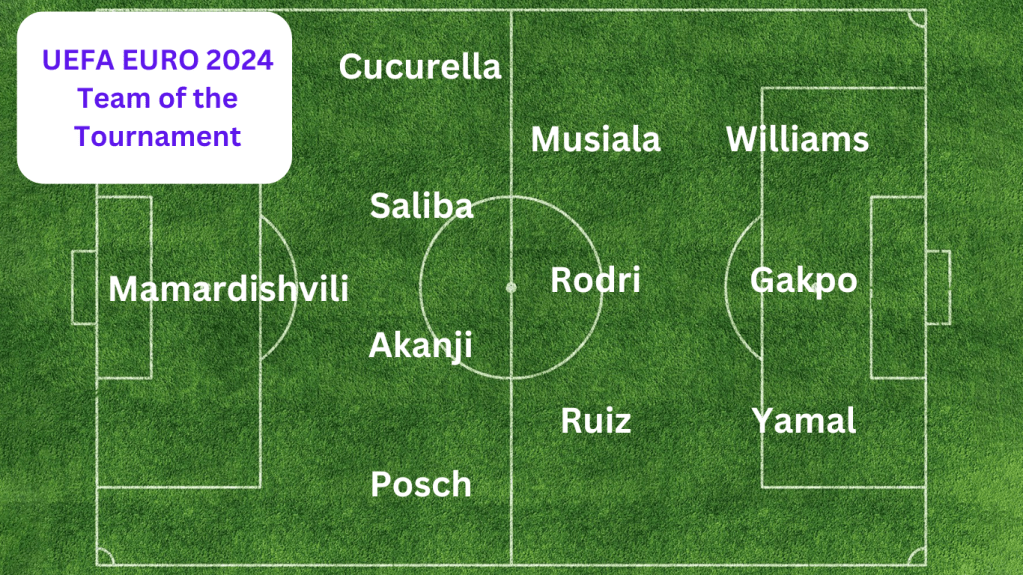
So, after a month of own goals, early goals, plenty of old-fashioned screamers and England continually putting us through at least ninety minutes of torture and then giving us about ten seconds of pure elation, these are my picks for the best players of the tournament, with a deliberate push for variety, because quite frankly Spain were so much better than everyone else I could have just written out their entire team.

Goalkeeper- Georgi Mamardashvili (Georgia )

Honourable Mentions: Jan Oblak (Slovakia); Mert Gunok (Turkey)

It says a lot about the way the tournament went that there were actually a number of contenders for this position. Diogo Costa, Jordan Pickford and Unai Simon were all impressive, but they played for the leading sides, whereas it was the less-heralded nations where the goalkeepers really stood out. I nearly went with Gunok for the last-minute save against Austria alone, but for the sheer volume of saves he made (including 11 in one game against the Czechs) it has to be Mamardishvili, who looks like the continent’s next superstar between the sticks.

Right-Back- Stefan Posch (Austria)

Honourable Mentions: Jules Kounde (France); Denzel Dumfries (Netherlands)

In contrast, there were a lack of outstanding candidates at right-back, so I’m going for a player who went out in the last sixteen. Austria lit up the group stage, topping their group above France and Netherlands, and their full-backs were a major part in their full-throttle football. Posch was tireless in his runs up and down the right-flank and looked a big threat around the box as well. He plays his club football with Bologna, who have just finished third in Italy, so his time on the big stage may not be over yet.

Centre-Backs- Manuel Akanji (Switzerland); William Saliba (France)

Honourable Mentions: Jaka Bijol (Slovenia); Marc Guehi (England)

The cruel nature of top-level football is that one unfortunate moment can define your tournament, in spite of your consistent efforts throughout. That was certainly the case for Manuel Akanji, who was imperious for an impressive Switzerland in every game (especially in a heroic rearguard effort against Germany) and whose decisive penalty miss against England wasn’t enough to deprive him of a spot here. Amidst stiff competition from unheralded Bijol, who won every header against both Kane and Ronaldo, and Guehi, who was arguably England’s player of the tournament, the other slot goes to Saliba, who has entered “so good it looks effortless” territory and was the cornerstone of the best defence in the tournament.

Left-Back- Marc Cucurella (Spain)

Honourable Mentions: Ferdi Kadioglou (Turkey); Nuno Mendes (Portugal)

For anyone calling any Chelsea bias here, I was honestly going to pick Kadioglou until the final, as he had been the most dynamic, fun-to-watch player in the tournament in my view. But Cucurella’s perfect assist for the winning goal was the culmination of a remarkable comeback story. Him going from a joke figure and being openly identified as Spain’s weakness by Gary Neville to becoming a key cog in the Spanish winning machine was one of the tournament’s best narrative subplots.

Centre-Midfield- Rodri (Spain); Fabian Ruiz (Spain); Jamal Musiala (Germany)

Honourable Mentions: Granit Xhaka (Switzerland); Vitinha (Portugal); Christoph Baumgartner (Austria)

I’m playing a 4-3-3 (in case you were wondering) and that meant I was spoilt for choice when it came to selecting elegant midfielders who specialise in dictating the game. None however do it better than Rodri, the official player of the tournament, and surely now recognised as the best player in the world full stop.

His partner in crime was Fabian Ruiz, who was unlucky not to win the best player award himself such was his contribution to the Spanish side, with two goals and two assists and plenty of stylish footwork to boot.

The third spot was harder to pick, but I went with Jamal Musiala, who was incredibly unlucky to go out at the quarter-final stage, as the best player of a German team who probably would’ve beaten everyone but Spain. Musiala scored three times and continued to slalom through defenders like they were training cones. Like a lot of others, this tournament seemed to be the moment he elevated himself to a new level, from exciting talent to team talisman.

Right-Wing- Lamine Yamal (Spain)

Honourable Mentions: Arda Guler (Turkey); Bukayo Saka (England)

Let’s be honest, it was always going to be Yamal here. Guler and Saka had impressive tournaments of their own, but all the hype around this (just) seventeen-year-old is justified. It’s his decision-making that sets him apart, along with his consistency in delivery, clocking up a tournament-high four assists. His goal against France has probably already become a little overrated, but that’s because everyone recognised it as the moment the starter pistol was fired on what will surely be a storied and extraordinary career.

Left-Wing- Nico Williams (Spain)

Honourable Mentions: Dan Ndoye (Switzerland); Kvicha Kvaratskhelia (Georgia)

On the other wing is the true ‘breakout’ star of the tournament. I say that because, unlike the likes of Yamal and Guler, I had never seen Williams play before the Euros started. And now he’s probably the hottest property in European football. Him and Yamal join an esteemed list of iconic pairs of wingers, that includes the likes of Salah and Mane and Robben and Ribery. As England and basically everyone else discovered, if one doesn’t get you, the other one will.

Centre-Forward- Cody Gakpo (Netherlands)

Honourable Mentions: Ivan Schranz (Slovakia); Georges Mikautadze (Georgia)

And we reach the hardest position of them all to pick. Was this tournament the last dance of the traditional number nine? Kane, Lukaku, Lewandowski and Ronaldo all massively disappointed. Even for the irrefutable champions Spain, everyone knew that their weak spot was Morata upfront, even if he did selflessly work his socks off for the team.

With six players sharing the golden boot, I couldn’t even pick it off stats alone, and I genuinely considered putting in the astonishingly underrated Dani Olmo here as a false-nine, as the player with the most goal contributions overall. To avoid picking yet another Spain player, I’ve gone for Gakpo instead, as he is ‘technically’ a striker, even though all of his goals came from playing off the left… Beyond him, I was left with the choice of two strikers who play in the Czech and French second leagues respectively.

Actually, maybe I’ll just play with ten.

Premier League Predictions 2023-24

It’s that time again! Christ I’ve missed football this summer; I have honestly not known what to do with myself. We are due to have the most “normal” Premier League season for a good number of years, with no mid-season World Cup and no Covid breaks or delays (we hope!). I’ve deliberately left the predictions as late as I can this year, as last-minute transfers can have such an impact on the prospects of the various sides, though I’m sure there will be plenty more twists and turns before the window shuts on September the 1st. Here’s how I see this latest instalment of the greatest league in the world playing out…

20th– Luton

I was so pleased that Luton got promoted as it proves that even in an era of money-dominated ‘superclubs’, anyone can still reach the highest level. We will see Premier League football at the smallest stadium in the competition’s history (yep the one with the terraces in the back gardens etc) and I think Luton can use that to their advantage to shock a few of their more glamorous rivals. However, their squad is the weakest I’ve seen in many years and it would be a genuine miracle if they manage to survive after 38 games. Romance can play a part, but quality will always tell in the end.

19th– Sheffield United

Sheffield United are a strange addition to the top division this year, as they’re actually suffering from financial uncertainty off the field, which means that they aren’t able to invest and improve the squad as you normally would when getting promoted. The last time they played a Prem season with full fan support, they turned Bramall Lane into a fortress and were the division’s surprise package. Whilst I imagine they’ll be tough to beat, I don’t see a repeat of that achievement this time around.

18th– Bournemouth

Bournemouth are a real wildcard for me this year. On paper, they seem to have shot themselves in the foot, by sacking the manager that pulled off one of the most underrated escape acts of last year in Gary O’Neill and replacing him with the relatively unknown Andoni Iraola, without significantly improving a fairly weak squad. This will either go one of two ways: Iraola will live up to some of the hype and become the next Pochettino or De Zerbi, or it will prove a disaster and he’ll be gone by Christmas, with a desperate phone call to Big Sam coming too late to stop the bleeding. I’m personally betting on the latter.

17th– Fulham

Is anyone else getting a strong whiff of second season syndrome?.. I’m sorry Fulham fans, it may feel like I have an agenda against you as I predicted you to go down last year, and now I’m predicting another season of struggle. Fulham were brilliant last year in finishing 10th on their return to the top flight, making me look a fool in the process, but the underlying numbers showed they were over-performing on a lot of metrics (as promoted teams can sometimes do) and the uncertainty over Mitrovic’s future isn’t helping. If he goes, I don’t see where they’ll get enough goals from to match last season’s comfortable finish and so a relegation battle may be on the cards instead.

16th– Everton

I mean, does this even need an explanation? This is just where Everton’s level is now, which is a travesty for a club with rich history and lofty ambitions. Squad-wise, they seem to get thinner and thinner every year, but finally made a sensible decision in appointing Sean Dyche. He kept them up on the last day last year and I think his nous and uncompromising, risk-free style will be just enough to keep them up again. You know it’s not going to be pretty though.

15th– Wolves

Wolves seem to be on a worrying downslide. A few years ago, they looked the most credible threat to the traditional establishment, with their investment in talented (almost exclusively Portuguese) players and back-to-back 7th placed finishes, including a run in the Europa League. That seems a world away now, with the spending having dried up and their best players moving on. Similarly to Everton, their biggest asset is their manager, with Julen Lopetegui doing a great job in turning their fortunes around last year. If he stays for a full year (and that looks very shaky) they’ll stay up. If he goes early and they don’t pick a sensible replacement, they could emulate Leicester and Southampton and find themselves falling through the trap door.

14th– Burnley

Burnley are fashionable all of a sudden. Vincent Kompany’s arrival and subsequent steamrolling of the Championship, with a new possession-based and exciting brand of football, has drawn a lot of attention to the Clarets. The Premier League will obviously be a much bigger challenge, but I think Burnley may benefit from a weaker-looking bottom half this year and ride their new momentum to a comfortable mid-table finish. That will only boost Kompany’s reputation further, and how long they can keep hold of the former Man City captain may become an intriguing narrative going forward.

13th– Brentford

Last season showed a lot of people, myself included, that you should never write off Brentford. The Bees have been brilliant since their promotion to the big time, but this season will pose a unique challenge, with their talisman Ivan Toney banned until January for betting offences. I think they’ll find it tougher for the first half of the season without the 20-goal forward, but the stage is set for Toney to return, Cantona-like, from his ban and lead Brentford comfortably to safety.

12th– Crystal Palace

If anyone read my reactions at the end of last season, you’ll see I’m sticking with my claim that Palace are the easiest, and therefore dullest, team to predict every year. They have finished between 11th and 14th for seven straight seasons and I’m tipping them to make it eight. It will be interesting to see how they cope without Wilf Zaha, but to be honest, Eze and Olise have higher ceilings and should relish having more of the limelight. Plus, whilst he’s not exactly the sexy choice, Roy Hodgson is as close as there is to a guarantee of avoiding relegation.

11th– Nott’m Forest

Time for the risky prediction! I like to throw one in each year, and whilst the rest of my bottom half is probably pretty similar to most people’s, I’m tipping Forest to be the surprise package and take the mantle as ‘best of the rest’. They just about avoided relegation last year on their return after 20-odd years away, despite a bizarre strategy of signing nearly thirty new first-team players. They’ve been much more reserved this time around, which I think speaks to Steve Cooper finally working out his best team. An exciting front three of Brennan Johnson, Awoyini and Gibbs-White started to click in the final ten games and if they can consistently produce across a whole season, I think Forest can build on, and better, last season’s nervy finish.

10th– West Ham

Someone might want to tell West Ham they’ve got a gaping hole in their starting eleven, and over a hundred million to do something about it. Here we are, a week before the season’s start, and the Hammers are yet to make a single signing, despite letting inspirational captain Declan Rice leave for Arsenal. This means that, instead of riding the wave of their sensational Europa Conference League triumph, they start the new campaign feeling a bit flat. My prediction is that David Moyes will be the first manager sacked (as he should have gone out on the high of that win in Prague) but that a new manager and those late reinforcements that will surely come in over the coming days and weeks will be enough to take them to a top-half finish, which is really where they should be.

9th– Brighton

It seems more apparent than usual that this year’s division is already split into two, or more accurately into a top 9 and a bottom 11. I don’t think any of the teams I’ve already mentioned will reach any higher than tenth and I don’t think anyone from this point will stoop below ninth. Its these two mini-divisions that are interesting. And I’m going with everyone’s second team, Brighton, first, but only because I hope and think that they’ll have a long run in the Europa League and will therefore have to de-prioritise certain Prem games over the course of the season. You could use the default “rebuilding” excuse considering they’ve once again lost key players, but that just doesn’t seem to apply to the Seagulls. I expect them to continue to thrill and shock the big boys, but matching last season’s sixth place may be a step too far.

8th– Tottenham Hotspur

Is any side going into this season in a bigger state of chaos? Spurs have once again changed manager, appointing the impressive but unproven at the top level Ange Postecoglou. Harry Kane could well leave before their first game, and they still haven’t strengthened in key areas. They’ve made some good additions, like James Maddison, but they still seem way short of their rivals and if Kane was to leave without an adequate replacement, it feels like the sky could well and truly cave in. The only silver lining for Tottenham fans is that the last time I predicted Spurs to finish eighth, they appointed Antonio Conte mid-season and stormed into the Champions League. Good omens is the best I can offer at this point.

7th– Aston Villa

Aston Villa have seemed to be threatening to break through to the elite for a few years now, with a string of impressive and ambitious transfer windows. The final piece, as it always is, was finally appointing the right manager and they’ve certainly got that now with Unai Emery. His remarkable record since his appointment in October, coupled with a few more big signings in Pau Torres, Youri Tielemans and Moussa Diaby, means that Villa are equipped to push for the Champions League this time around. However, they will surely go all out to win the Conference League, inspired by the effect that competition had on West Ham, and this may mean, like Brighton, they have to pick and choose their best eleven during the season’s closing stages and allow their rivals with bigger squads to squeeze in above them.

6th– Chelsea

Never have I gone into a season less sure of where to place my own team. The scale of Chelsea’s disaster last term means that all bets are off, with the mother of all rebuilds having taken place over the summer, and with some glaring holes still apparent in the starting eleven. My head tells me that there is too big a gap to close on last season’s top five, who have all strengthened again. My heart tells me that we have made some sensible decisions (at last!) in appointing Pochettino and in getting rid of the dead wood and bringing in some young and hungry replacements. Time will tell, but I’m using Pochettino’s first season at Spurs as a good reference point: a steady but unspectacular Europa League qualification, before peaking in seasons two and three. Let’s be honest, it can’t possibly be any worse than last time.

5th– Newcastle United

The big six is now, at the very least, a big seven. Newcastle are back in the Champions League at the first real attempt and they’re not going anywhere. Their spending has made a mockery of the scattergun expectations of the Saudi ownership, with further steady and sensible additions this summer (Todd Boehly could learn a thing or two!) and Eddie Howe has somehow outperformed some fairly high expectations as manager. I personally can’t wait to see the atmosphere at midweek European games at St James’s and once they have the taste for it, they’ll want to make it an annual event. The only caveat here is that I think they capitalised on a bad year for the traditional contenders last year, with Tottenham, Chelsea and (to a certain extent) Liverpool having a complete nightmare. That won’t happen this time and so the Magpies may have to take a small step back, before their inevitable next leap forwards.

4th– Manchester United

The placing of the next three teams was the hardest part of this set of predictions, and they could be rearranged in a different order very easily, but I’m hesitantly putting United fourth for now. For once, I actually really rate their transfer business: Onana is a huge upgrade in every modern goalkeeping department, Mount broke my heart by leaving Chelsea and remains so underrated by the wider football public and Holjund looks a future superstar. Erik Ten Hag also proved last year that they finally have the right man in charge. The only negative I can come up with is that their forward line still looks weak compared to the three I’ve put above them. Maybe Holjund will solve that issue in time, but he looks a signing for the next two or three years, rather than the here and now, and so United will once again have to settle for close-but-not-close-enough this season.

 3rd– Liverpool

My record in predicting Liverpool is abysmal. Two years ago, I predicted them to just about scrape Champions League, and they ended up two results away from doing the Quadruple. Last year, I had them as league winners and they preceded to have a disaster for most of the season, only salvaging 5th place with a last-minute resurgence.  They’re clearly going through a transition, losing key figures like Milner, Henderson, Fabinho and Firmino, but I love the signings they’ve made and their forward line is still arguably the best in the league. They will undoubtedly be better than last year; the question is whether they can improve enough to again be City’s one true nemesis.

2nd– Arsenal

When the hell did Arsenal get good again? For nearly the entirety of my football-watching life, the Gunners have been the most entertainingly predictable side: showing glimpses of potential before ultimately missing out where it matters. And then, out of nowhere, Mikel Arteta conjured up a title-challenging side last season, and has improved it further with the addition of Rice, Timber and (maybe…) Havertz. The question marks remain over their mentality in the high-pressure matches, but I would point out that there’s no shame in being second best to the best side in Premier League history. And I’m afraid that’s where I see their destiny once again. They’re really good, but just not as good as…

1st– Manchester City

I made the mistake last time of daring to pick someone else as title winners, and I was taught a harsh lesson. City are this generation’s equivalent of Liverpool in the 70’s/80’s and United in the 90’s. The dominant, metronomic force, where it takes something truly remarkable (a la Liverpool’s 99 points in 19-20) to overcome them. Even more worrying is that they’ve finally laid their Champions League demons to rest by completing the treble in Istanbul. As insane as it seems, I think Erling Haaland will actually improve on last season’s goal tally and despite some key departures, Guardiola will probably once again develop a new tactical innovation that catches everyone else out. The sad reality is that the Premier League’s other contenders all know they are waiting for Pep to leave before they can finally topple the goliath that his City have become. 

Reacting to my Premier League Predictions 2022-23

Another one bites the dust. The 2022-23 Premier League season is officially in the books. And with the World Cup taking place in the middle, this has felt like a longer, more arduous campaign than most, or maybe that’s just because I’m a Chelsea fan…

The final day lacked some of the drama from the previous campaign, but there have been so many memorable moments throughout the last ten months. Thomas Tuchel and Antonio Conte just about having time for an iconic scrap before both left their respective jobs; Erling Haaland’s inhuman early season scoring spree, including three consecutive home hat-tricks; a below-par Liverpool somehow beating an improved Man United 7-0; Arsenal’s excellent surprise title charge and then subsequent bottling; Spurs putting in an entry for the Spursiest moment of all in going 5-0 down in 20 minutes against Newcastle and then topping it a week later by coming back from 3-0 down at Anfield only to immediately concede a late winner.

This has also been a season that has some claim to be the most unpredictable of all, with some startling fluctuations in form from both the division’s most well-known and lesser-heralded sides, whilst the most manic of all managerial merry-go-rounds hasn’t helped in maintaining a more traditional order of things.

So yes, I got my excuse in early. It was a really hard one to predict. Perhaps you’ll bear that in mind as I shamefully reflect on my predictions from back in July…

20th– Southampton
My prediction- 19th

I said: “My prediction is that they have a difficult start, panic and fire Ralph Hasenhuttl and then end up even worse off.”

How it turned out: Boom! What a start. And some long-awaited vindication as I’ve actually been calling this for a few years. The Saints had been circling the drain for a while and made the exact mistake I foresaw: sacking Hasenhuttl and replacing him with the hopelessly out-of-his-depth Nathan Jones. A stern lesson that investing in inexperience, both in terms of players and managers, rarely pays off.

19th– Leeds
My prediction- 16th

I said: “It feels like it could either be a disaster or a much-needed change, but for now I’ll say they’ll just about avoid the drop.”

How it turned out: It was a disaster as it turned out. Again a case of the grass not always being greener when it comes to sacking managers. Though in truth, Leeds have had a complete identity crisis since Bielsa left, and without his insane brand of football, they have been exposed as nothing more than a bang-average team who concede far too many goals.

18th– Leicester
My prediction- 8th

I said: “I think a lot of people are sleeping on Leicester this year. I think they still have the best attack outside of the big six. Barnes, Vardy and Maddison, with Daka to come in, is firepower the other teams around them can only dream of.”

How it turned out: Oh Christ. And this is where the laughable predictions begin. In fairness, Leicester being relegated was a surprise to most, after a number of seasons of being the ‘best of the rest’ outside of the top six, but there were definitely some worrying signs going into this campaign that I seemed to ignore. My comment on their attacking powers was valid, it was just that their defence was so shambolic that it still wasn’t enough to save them.

17th– Everton
My prediction- 15th

I said: “I think their season hinges on if Dominic Calvert-Lewin can stay fit. If he does, you’d think he would score enough to keep them clear of danger. If he doesn’t, then they may finally fall down that dreaded trap door of relegation.”

How it turned out: Well, Calvert-Lewin didn’t stay fit and they just about stayed up by the skin of their teeth. Their current role as annual relegation battlers is the product of endless bad decisions at boardroom level, but they might have finally made a good one in appointing Sean Dyche. I’m not sure anyone else could have kept this sorry mob up.

16th– Nott’m Forest
My prediction- 14th

I said: “I like to throw in one bold prediction each year and here is this year’s version. Nottingham Forest to stay up, and comfortably so. I think they’ll basically do a Brentford and spend most of the year comfortably in mid-table, rather than scrapping for their lives at the bottom.”

How it turned out: This was a real rollercoaster watching this prediction play out. At first, it looked another disaster as they just wouldn’t stop signing players and seemed to have pulled a classic “too many cooks”, before an upturn in form at the start of 2023 began to make my claim look feasible. And then they got dragged into the relegation battle once again, but found a final burst of form right when it mattered to ultimately avoid the drop.

15th– Bournemouth
My prediction- 20th

I said: “And for me, the weakest of the three (promoted sides) looks to be Bournemouth. Unfortunately for the Cherries, I fear their Premier League return may be short-lived.”

How it turned out: Arguably the surprise package of the season and certainly one of the most underrated managerial performances from Gary O’Neil. Everyone had written Bournemouth off, with a weak-looking squad and a dreadful start that included a 9-0 thrashing at Anfield. And yet they recovered superbly and ended up surviving relatively comfortably in the end.

14th– West Ham
My prediction- 7th

I said: “I don’t see them finishing any higher than seventh, which is why they should go all out to win the Europa Conference League.”

How it turned out: Well they didn’t finish any higher than seventh! This was a bad prediction with some really solid reasoning behind it as I basically explained that the Hammers should put their energy into winning the Conference League, which they have done, but at the complete cost of their previously solid league form. Still, if they can defeat Fiorentina in Prague, the mid-season struggles will all be worth it.

13th– Wolves
My prediction: 11th

I said: “It’s been a strange old summer for the old gold, after a promising first campaign under Bruno Lage. Like Brighton, they’ll be absolutely fine, but might regret not kicking on when they had the chance.”

How it turned out: I guess this is kind of right? Wolves’ season was another that started awfully under Lage and interim boss Steve Davis, but hiring Julen Lopetegui after the World Cup was an astute appointment and he took them to comfortable safety in the end. They should heed the warning of what has happened to Leicester though, as the second you stop moving forwards in this league, you start falling fast.

12th– Chelsea
My prediction: 4th

I said: “Based on squad depth, the Blues are still the side best placed to push Liverpool and City, but a rejigged defence and possible change in formation might mean its still too soon for a proper title challenge.”

How it tuned out: I mean, where do I start? I’m not going to go on forever as I’ve already written separate blogs at different stages of Chelsea’s disastrous ‘annus horribilis’, but the best way to sum it up is that this prediction went through various different stages over this season: from overly-optimistic to misjudged to pitiful to frankly laughable. A fitting guide to the fortunes of the club itself.

11th– Crystal Palace
My prediction- 13th

I said: “I wouldn’t be surprised if they made a push for European Football this year. It’s just the strength of their squad that might hold them back, as if Zaha gets injured, you wonder where the creativity and goals will come from.”

How it turned out: Again, not bad, but Palace are the easiest side to predict year in year out. Top of the bottom half. Never anywhere near the European race but never looking in danger of relegation either. That’s possibly an unfair appraisal of their season as it was only Roy Hodgson’s latest resurrection that inspired their free-flowing improvements in the latter half, but its telling that I’m fairly confident I’ll be putting Palace in exactly the same place come August.

10th– Fulham
My prediction- 18th

I said: “Ah Fulham. Welcome Back! And… see you later. The precedent has been set by their previous two years in the top flight and whilst I must admit I think they will put up more of a fight than they did in those two campaigns, I still think they will fall just short.”

How it turned out: Another one I got badly, badly wrong. I think I was scarred by predicting Norwich to survive the previous year and had got sucked into the memes of those two clubs being in an endless promotion-relegation spin cycle. Instead, Fulham have been great, Marco Silva has proven himself in the top flight and they’ve even showed they are more than a one-man team when Mitrovic has been missing.

9th– Brentford
My prediction- 17th

I said: “Putting them so low this time around is down to two simple factors. Second season syndrome and the lack of Christian Eriksen.”

How it turned out: And… another one. I told you I had a nightmare this year. The logic behind my placing of them as relegation battlers was obviously steeped in football cliches, but the Bees have shown that they are far too well-run to fall victim to those. They’ll have even bigger shoes than Eriksen to fill next year with Ivan Toney being banned for his gambling issues, but I certainly won’t be making the mistake of writing them off again.

8th– Tottenham
My prediction- 3rd

I said: “Conte may be able to turn Spurs into genuine title contenders and even finally win them a trophy. Quite frankly, if he can’t do it with this squad, then no-one can.”

How it turned out: It’s easy to forget, but my view on Spurs ahead of the season was actually a pretty common one. Based off their late surge to the Champions League from the previous campaign and some big-name signings, things seemed to finally be on the up. And then it all spectacularly fell apart. How Harry Kane scored 30 goals for a side this average is anyone’s guess. And god knows who they get in next as manager. They seem to have become football’s ultimate poisoned chalice.

7th– Aston Villa
My prediction- 10th

I said: “It’s a really important season for Villa, and for manager Steven Gerrard, as it feels like both have big ambitions that need to come to fruition sooner rather than later.”

How it turned out: Well, Villa’s ambitions did come to fruition. Gerrard’s certainly didn’t. Aston Villa this season might be the perfect example of how important a good manager is to a club. Unai Emery turned a lifeless side who played the most uninspiring football in the division into a well-oiled machine who stormed to European football. And with Emery’s record in continental competition, they’re surely odds-on to win the Conference League next season.

6th– Brighton
My prediction- 12th

I said: “I still think they’ll be solidly mid-table, but another top-half finish might be too much of an ask for a squad undergoing a minor rebuild.”

How it turned out: Like Brentford, Brighton are another club who laugh in the face of traditional football logic. Sell your best players? Lose your manager after only six games? Only sign unknown youngsters from the world’s untapped markets? Have your best-ever league finish, qualify for Europa League, reach the FA Cup semis and do it all by playing tactically fascinating and eminently watchable football. They are the club of the moment. And they deserve to be.

5th– Liverpool
My prediction- 1st

I said: “My thinking is based on recent history, as I think from a mentality point of view, the motivation of winning the title after coming so close last year is possibly stronger than if you were trying to retain it, as we saw in 2019-20 when Liverpool finally broke their 30-year drought.”

How it turned out: Again, who saw this season coming from the Reds? Considering how bad it was at one stage, they actually did quite well to recover to get fifth, which says it all when a year previous they were not far off a quadruple. They’ll come again, you would think, but there’s no getting away from the fact that my predicted champions barely made it off the starting blocks in the title race.

4th– Newcastle
My prediction- 9th

I said: “It might actually prove to be a smart move to steadily add to the solid foundations Eddie Howe has already managed to build in his short tenure as manager and I think at the very least, they will start the season aiming for Europe, rather than fearing yet another relegation battle.”

How it turned out: It was telling that in the player interviews after Newcastle had clinched Champions League football with a home draw against Leicester, they all mentioned that top ten was a realistic target at the start of the season. They are so far ahead of schedule in terms of the sporting project taking shape on Tyneside and that is all down to the management of Eddie Howe. He doesn’t get the credit he deserves, because of their new and controversial riches, but returning the club to Europe’s top competition constitutes a huge over-achievement.

3rd– Manchester United
My prediction- 5th

I said: “I think it would take one of last season’s top four to undergo a serious drop in form for United to sneak in to the Champions League places, so it will have to be slow and steady progress for Ten Hag in the league, and perhaps a focus on winning a cup instead.”

How it tuned out: Considering how shocking some of my other predictions have been, I’m actually going to give myself some credit here. United have surprised me a bit, but essentially they have benefitted from Liverpool and Chelsea dipping dramatically and they did focus on winning a cup (could even be a double). Ten Hag deserves loads of credit as he inherited a real mess, but the question with United is can they sustain this upwards trajectory? They’ve had a lot of false dawns before.

2nd– Arsenal
My prediction- 6th

I said: “They’ve spent some serious money, but they have a gift for signing players they don’t really need. I may be wrong, but it feels like they may have actually lost ground in the race between the big-boys.”

How it turned out: Don’t mind me, I’m just stuffing my face with the world’s biggest humble pie. Inspired by those signings that apparently they didn’t need, Arsenal embarked on their first serious title charge in a decade and at one point, looked like they might do the unthinkable and actually win the thing. They’ve taken some stick for falling at the final hurdle, but looking back at the predictions of idiots like me shows just how good a season it has been for the Gunners.

1st– Manchester City
My prediction- 2nd

I said: “Even with Haaland joining, I would argue their squad is ever so slightly thinner than in the last few years. I’m almost talking myself out of this prediction as I write it, but just for the sake of a change, I’m going to say City, for once, will have to settle for second.”

How it turned out: I should’ve talked myself out of it. Sometimes the obvious choice is obvious for a reason. And when the reigning champions add the best striker in the world to their ranks, they should have been nailed-on to retain their title. Their dominance is turning the Premier League into a one-horse race and they might earn a further place in history by completing a stunning treble. I’ll be putting them first next time, no doubt about that. 

Football Top 10’s- Most Underrated Goals of All Time

This is a blog I’ve been thinking about for ages and one that requires minimal effort from me but hopefully creates lots of enjoyment for the reader. The best thing about football is goals. Whether they’re tapped in from a yard or smashed in from thirty, showcase sensational technique or awe-inspiring agility, are works of individual brilliance or complete team synchronisation. And we all know the classics. The Van Basten volley. The Maradona non-handball one against England. Zidane in the Champions League Final. Rooney’s overhead kick. The list goes on.

So, I want to shine a light on the great goals that you may either have missed, or entirely forgotten. The hidden gems of the screamer section. This is totally subjective of course and speaks just as much to the kind of goals I like, as it does to which of them actually has the most merit, but I’ve tried to diversify as much as I can and pick a different goal for each slot in this top ten. A disclaimer also goes out here that I’m not including goals that are so often called underrated that they can no longer in fact claim to be underrated- the epitome of this is Pajtim Kasami’s worldie for Fulham at Selhurst Park.  

And so without further ado, and with all clips provided, please enjoy this selection of some of the game’s secret stunners.

#10- Gareth Bale vs Sunderland (Premier League, 2013)

Okay, so there’s a reason this is number ten. It’s the least unique goal of any of this collection, in the sense that a lot of players have hit thunderbolts into the top corner over the years and Bale himself has done it on the regular. But there’s just something so strangely satisfying about this one. It’s the way he allows the ball to spin up onto his chest, the way he stands dead still as the terrified defender backs off, the way he shifts it just enough to wrap his foot around it. This was Bale at his very best; his final season at Spurs where he was the most feared player in the land and he would win matches all on his own. This was also an 90th minute winner on the final day, so in many ways he fittingly saved his best till last.  

#9- Olivier Giroud vs Sweden (World Cup Qualifier, 2017)

Now for another man who has made a career on scoring spectacular goals. Think of Giroud and everyone thinks of the scorpion kick, but my favourite goal of his is this lesser-known gem for his country in an unremarkable World Cup Qualifier. I just have a thing for self-set-up goals; it’s the skill I have attempted (to no success) the most. It’s just so damn sexy. While the best of this category is surely Ruben Neves vs Derby, that’s too well-known and this one from Giroud is nearly as good, with the way the ball arcs in from outside the post just adding to the sumptuous technique on show. Merci Olivier.

#8- Cristiano Ronaldo vs Liverpool (Champions League, 2014)

This might actually be my favourite goal of all time. I know, it’s a rogue shout. It’s one I remember watching live and thinking that the commentators and pundits weren’t making enough of a fuss over and it just gets better with every new watch. It’s only so low on this list because there’s nothing out of this world about it, but for me, it’s a showcase of elite-level football at its very finest. Madrid pass the ball around, working it through the thirds, and then it comes to Ronaldo, who plays a one-two with James Rodriguez. Rodriguez has ended up having a frustrating and arguably underwhelming career, after his glittering introduction at the 2014 World Cup, but he’s always possessed that maverick talent that I love, and here is a prime example. Control with the right, inch-perfect dab with the left and Ronaldo rushes on to it bury a chance that I think only he in his prime could finish so emphatically. Beautiful.

#7- Lionel Messi vs Arsenal (Champions League, 2011)

Where Ronaldo appears, Messi inevitably follows. Another goal in the Champions League. Another against an English side. Another that probably doesn’t even make the top thirty in either legend’s astonishing career. But another work of sheer genius. For me, the joy of watching top-level football is seeing a player do something that the average footballer could not only fail to do, but something they would fail to even think about. We’ve seen this scenario a million times: attacker is put through one-on-one with the goalkeeper with the ball bouncing slightly awkwardly. Sometimes players will get good contact and score, sometimes they’ll dummy the keeper and go round him, sometimes they’ll miscontrol or scuff it entirely. No-one, bar Lionel Messi of course, would consider flicking the ball straight up, so that the keeper dives under it, and then volleying into the empty net. The best player to ever play the game and here is a perfect example of why.

#6- Luis Garcia vs Anderlecht (Champions League, 2005)

You know a goal’s underrated when there’s only a blurry 6-second clip of it. A top ten goal compilation wouldn’t be complete without a headed effort, and this is arguably the hardest to pick, as its so difficult for a header to stand out. This effort from Luis Garcia against Anderlecht does exactly that however. A. He’s on the edge of the box when he makes contact. B. He’s facing the wrong way. C. There’s not even that much pace on the cross. It’s all generated by his neck muscles and body position (watch to the end and pause on the close-up of the contact, it’s all so deliberate). The greatest header ever? Possibly. And it’s a goal few people will ever have seen.

#5- Elano vs Newcastle (Premier League, 2007)

Now for my free-kick pick. There have been some iconic goals in this particular genre, such as Ronaldo vs Portsmouth, Beckham vs Greece, Ward-Prowse vs Wolves etc. This might just be my favourite though. Elano was not the first or last to go for the laces/knuckleball style of shooting from a dead-ball, but I’ve rarely seen someone go for the keeper’s side when using that technique. He says to Shay Given: I don’t care that you’re there, this fucker’s going in anyway. And he absolutely rips it up, hitting the very definition of top bins. It’s got wobble, it’s got pace, it’s got height. It pretty much has everything. Shout out to the commentary as well, which just adds to the enjoyment.

#4- Luis Suarez vs Newcastle (Premier League, 2012)

Funnily enough, its Newcastle again on the receiving end of another one-in-a-million wondergoal, but this time five years later. I cannot for the life of me understand why this goal is never in the debate when it comes to the Premier League’s Greatest. People don’t even consider it Suarez’s best, as they tend to think about his multiple screamers against Norwich. But, referring back to my Messi entry, when someone does something so unique and impressive as this, it has to be celebrated. It’s a brilliant long pass from Luis Enrique, but a near impossible one to control, coming over Suarez’s head and with Coloccini on his back. And yet he does control it- on his fucking shoulder. An insane piece of balance and technique and strength, and he then has the presence of mind to calmly round the keeper and pass into the net. Astonishingly good. And I’ve not seen another goal anything like it.

#3- Radamel Falcao vs America de Cali (Friendly, 2012)

Full disclosure: the only reason this is not number one is because it was in a friendly. Now we all love an overhead kick; Ronaldo vs Juventus, Bale vs Liverpool, Rooney vs City etc. It’s such an impressive feat to reach the ball at a difficult height and connect well enough to find the net. It’s even more impressive when you’re scoring one from a corner! Honestly, the timing on this is just remarkable. He has to wait and make sure he jumps at exactly the right moment as the ball comes in from the corner flag. And unlike Rooney, there’s not an inch of shin involved; the connection is as clean as a whistle. Simply the best goal that I bet you’ve never seen or heard of.

#2- Matthew Lowton vs Stoke (Premier League, 2013)

To kick this off, this goal did not even win Goal of the Month. Which rankled with me at the time and has stayed with me ever since. Okay, so Van Persie’s goal against Aston Villa is a classic and was in a game that won United the title, but I’m sorry this is just better and it was in the last minute to win a crucial match in Villa’s relegation battle, not an easy title procession. The ball is dropping out of the sky, Matt Lowton has two players charging him down. He controls it perfectly on his chest and then unleashes a dipping volley that soars into the top right corner. And from a player who I don’t think ever scored again for Villa, if at all in his career. If that was someone like Neymar, it would be on a constant Instagram loop. Get the petition ready- #JusticeforLowton.

#1- Wilfried Gnonto vs Cardiff (FA Cup, 2023)

And so we reach number one and the whole reason I was inspired to start thinking up this list. Again, like Falcao’s, this will be forgotten because of the game in which it was scored in- a third round replay in which Leeds won at a canter, a game I doubt many people saw or even know happened. But for me, it’s the best goal I’ve seen in a long time. Everyone knows Paulo Di Canio’s iconic double-leg scissor volley against Wimbledon, and this is nearly as good as that. The most difficult thing in football is to connect with a ball from a distance as it is dropping in front of you. And he has the added factor of a defender being right in front of him, only just missing the header. To time the scissor kick that well and get so much power on it is sensational. It’s not a mishit, its right off the laces once more and its past the Cardiff keeper before he can even move. A recent contender, but one that deservedly takes the top spot of the most underrated goals of all time.