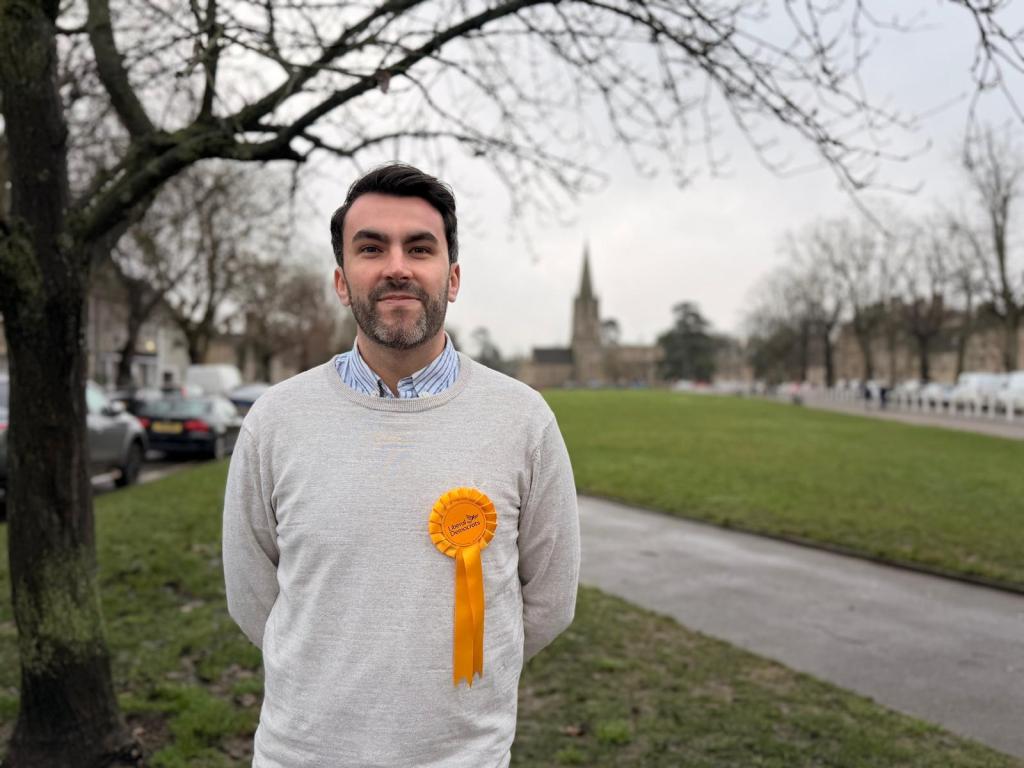
On Friday the 8th May this year, I found myself in a new and unfamiliar position: standing in the sports hall of my local leisure centre, the distant sounds of a spin class echoing in the background, as I watched the count of the West Oxfordshire District Council (yes, the one that Jeremy Clarkson hates) local election unfold. What made the whole thing even stranger is that I was specifically watching a pile of ballots that had my name on.
How did I get there? That’s a good question, and if you are surprised to read about this, I can assure you it was just as much of a surprise to me when the opportunity first came about. To cut a rather long and convoluted story short, the simple answer is that it all started when I met my local MP, Charlie Maynard, at a work event at the House of Commons towards the end of last year. Charlie is a shining example that there are still plenty of good politicians out there. He’s enthusiastic, personable and most importantly, genuinely cares about his constituency and its residents.
I told Charlie that I was interested in politics and would like to find out how I could get more involved and then a couple of months later, I was asked to stand as the Liberal Democrat candidate for the local council elections in my home ward of Witney East. To say this came out of nowhere was an understatement; I’m not actually 100% sure I had even ever voted in a local election before, and here I was being asked to stand in one. But, as the saying goes, in for a penny, in for a pound. So I accepted, and my campaign began.
In Christopher Nolan-style, let’s jump back to the future, and return to the count that happened on the 8th May. The results of my ward were confirmed, and I finished second on 633 votes, trailing the winning Conservative candidate by a few hundred. All of this is public record and you can see the results in full here if you’re interested. Given the unexpected nature of my decision to stand, I was pretty chuffed with this outcome. I knew it was the mother of all longshots to actually win given where I had started from, so second place and knocking Labour into third was about as good as I could have hoped for (although as you’ll have seen from the rest of the country’s results, I may have had a helping hand from a certain Mr Starmer in that, so cheers Keir!)
Now, this blog is certainly not meant to be a bitter attempt at disputing the results or at besmirching my fellow candidates, but rather a summary of my experience of standing and campaigning and the things that it has taught me about the British public and the state of our current political climate. I hope you find the below interesting and insightful, and if it encourages a few more younger people to get involved in local politics, then that would be lovely too.
A Lack of Perspective
The central part of any election campaign is canvassing. And if you didn’t know, that’s essentially the process of knocking on people’s doors and trying to convince them to vote for you. On the whole, I found this to be a genuinely brilliant experience. Social media may lead you to believe that we all live in a terminally divided society where people are just waiting for a chance to attack anyone who doesn’t share their own beliefs, but the reality is that we British are actually all rather incurably polite at heart.
We’re also more similar than you would think, especially when it comes to local issues, and whilst obviously there were specific things that would only be relevant to Witney, I’m sure this would be fairly universal across the country. People basically just want well-maintained roads, minimal disruption to their commutes, safe neighbourhoods and good services for their children. And this was true whether they were a Lib Dem Voter or not.
However, there was one theme that did start to irritate me the more I canvassed, and it wasn’t anything specific anyone said, but rather a frequent malady that many people seemed to suffer from, and that’s a lack of perspective. The amount of times I stood in the doorway (or sometimes even porch…) of an amazingly beautiful house on one of Witney’s many lovely secluded little cul-de-sacs, and listened to the home-owner tell me about how the town wasn’t what it used to be, and how everything had basically gone to ruin.
Now, please don’t misunderstand me. I wouldn’t have been running if I didn’t recognise that Witney does have some things that need fixing, but then so does literally every other town in the UK. And some of the issues that were regularly mentioned- decline of the high street, unsustainable growth in housing, busier roads- are literally just symptoms of the last 40 years of socio-economic development.
The problem is not that these people are wrong, they aren’t, but its that they seemingly have nothing to compare it to, and therefore are of the opinion that their particular situation is as bad as anyone else is facing. Without naming and shaming anywhere specifically, you wouldn’t have to venture far outside of West Oxfordshire before you quickly realised that actually maybe things really aren’t that bad at home after all. And this would be a useful exercise for everyone to partake in. The grass isn’t always greener on the other side, and it might just make you appreciate how good your own lawn is looking in comparison.
The Impression of Politicians
The other fairly universal theme amongst everyone I canvassed probably wouldn’t surprise you, and that’s the total and complete lack of faith in politicians of any kind. There were a lot of people who were so disenchanted by the whole system that they didn’t feel that they could vote for anyone, and there was also the general sense that it didn’t matter which party got elected, as there wouldn’t actually be any noticeable change. Difficult to argue with that.
The other thing that I found interesting was that people also seem to have a very strong fixed impression in their mind of what a politician looks and acts like. I genuinely lost count of how many times I was told that I seemed either “too young”, “too nice” or most worryingly, “too normal” to be running in an election. The young argument I kind of understand and accept, and the truth is that I probably was in the youngest 5% of people in the sports hall during the count. This is an issue, but one that can be resolved.
The other two were more damning, and speaks to how the public perception of what a politician is has now become so twisted that a lot of ordinary people just don’t think that other ordinary people become politicians anymore. Due to going through this process, I know that this isn’t true, and actually there are plenty of honest, decent people within politics, particularly at a local level. However, perhaps it speaks to the kinds of people who are most visible in the political sphere, and what attributes are most valued within Westminster circles. Fixing that is going to take a lot longer.
The Two-Way Impact of Reform
Phew, getting into slightly more controversial waters here. There’s nothing I can write about the Reform movement that hasn’t already been said- you all know the deal. It’s undeniably effective, and intrinsically divisive, no matter which side of that divide you fall on. You know which party I stood for, so you probably already know my stance, but that’s not what I want to talk about here.
One of the interesting side effects of the rise of Reform is the effect it is having on local elections, most notably in actual turnout, with nearly all wards in West Oxf seeing a huge increase in turnout percentage this year. This is obviously partly due to the rise in people voting for Reform that wouldn’t normally vote at all, but it’s also having a knock-on effect of motivating people to vote for anyone but Reform. I think for a lot of left-leaning voters, it’s one thing the Torys winning again, but its quite another to let Reform in.
One example of this sentiment is a gentleman who greeted me at his door with his fists raised, because he thought I may have been a Reform candidate. Luckily, he lowered them when I told him I wasn’t. Now, the picture will be different in every area of the country, but my experience is that the anti-Reform movement is just as fervent as the Reform one, and the issue is that people aren’t often sure which party actually offers the best chance of keeping them out.
As a final musing on this, I would be genuinely interested in the outcomes of a local or general election where voting was mandatory. Of course, you’d probably find a lot of new Reform voters who’d have otherwise stayed at home, but I guarantee you’d also find a lot of previously passive people now emboldened to find a reason to vote for literally anybody else.
We’re Not as Doomed as You’d Think
The final thing I learned was the most important one, and it is the main thing that I’ve taken from what has been an incredibly rewarding experience. I have been in the camp of the group that I mentioned earlier, feeling so downtrodden about both the political climate and system, that you start to lose faith in the concept as a whole.
I am delighted to report that is not the case any longer. Firstly, I have met so many wonderful volunteers that are the driving force behind any campaign. These people get involved because they care about their communities, often balancing or even sacrificing other commitments, because they’re passionate about the impact that politics can have. I also got to know many of my fellow Lib Dem candidates and I can say without fail they are all hard-working, kind-hearted people who want to make a positive difference, and I’m sure this is replicated across many other parties as well.
Which brings me on to my second point. Politics is inherently competitive, you’re trying to gain (in whatever small way that may be) over your opponents, and inevitably that can easily get nasty if you’re not careful. And yet for me, the heart of our democracy was best demonstrated on the election day, when I stood alongside a volunteer from the Labour and Conservative parties, as we collected the polling numbers of voters as they arrived at the polling station. There was no tension or conflict, we simply had a lovely chat and shared the numbers between us. It was an example of what UK politics still maintains at its core: an unspoken code of decency and respect.
Another example of this was that whilst watching my count, I got chatting to a Conservative candidate in a different ward. We talked openly about the issues we were passionate about, and had a really positive conversation where it became clear that we basically had the exact same values, and if there were areas where we disagreed, these were subtly different interpretations rather than insurmountable moral barriers. The truth is there are no right answers in politics, there are just some that are more wrong than others. And I’m certainly not claiming for a second that I instinctively and infallibly always know which are which.
So, that is my recount of an unexpected, exciting period in my life. Will I run again? I honestly don’t know at this point. Do I feel better about the state of our political institutions and the fundamentals of our democracy after standing?
Without a shadow of a doubt.

